 Search

October 15, 2026 • General
The Core Dangers of Irrevocable Trust to Beneficiaries in Arizona
When establishing an estate plan, grantors often hear about how irrevocable trusts can shield assets or reduce estate tax exposure. However, the reality on the receiving end is often vastly different. Once a grantor transfers property into an irrevocable trust, they surrender ownership and control. For beneficiaries throughout Scottsdale, Oro Valley, and Tucson, this permanence can lead to administrative bottlenecks, unexpected tax liabilities, and loss of financial independence. The dangers of irrevocable trust to beneficiaries are worth recognizing, as these drawbacks frequently outweigh the perceived benefits.
Under the Arizona Trust Code (governed by A.R.S. Title 14), irrevocable trusts operate under strict fiduciary guidelines. While a grantor may intend to protect wealth, rigid provisions often lock beneficiaries into financial arrangements that no longer match their life circumstances. In contrast, understanding Arizona probate avoidance via a standard revocable living trust often delivers clean asset transfers without tying beneficiaries to long-term fiduciary oversight.
The table below highlights how the core mechanics of revocable living trusts compare against irrevocable trusts from a beneficiary’s perspective:
| Feature | Revocable Living Trust | Irrevocable Trust |
|---|---|---|
| Asset Access Timing | Immediate upon grantor’s death (post-settlement) | Often delayed across years or milestone intervals |
| Tax Basis Adjustment | Full step-up in basis at grantor’s death | Frequently forfeits step-up if excluded from gross estate |
| Trustee Discretion | Minimal post-death; direct distribution standard | High discretionary power over income and principal |
| Annual Tax Filings | Flow-through to grantor (no separate Form 1041) | Requires annual Form 1041; highly compressed brackets |
| Modification Difficulty | Free to amend or revoke at any time during life | Requires decanting, consent agreements, or court petitions |
Understanding the dangers of irrevocable trust to beneficiaries helps Arizona families recognize when an irrevocable structure may complicate what should have been a straightforward inheritance.
Tax Traps and Financial Dangers of Irrevocable Trust to Beneficiaries
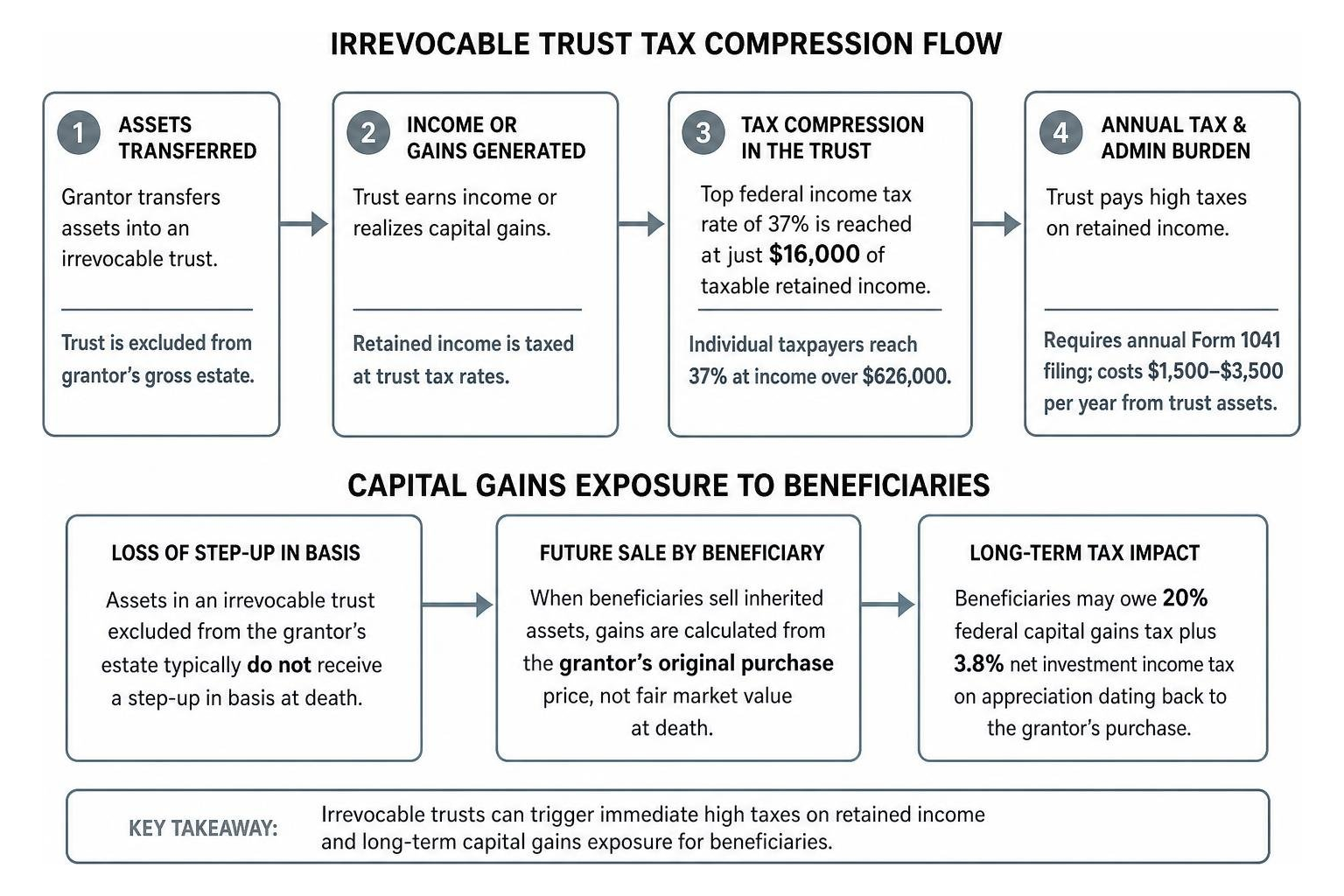
One of the most severe financial shocks for beneficiaries involves compressed income tax brackets. In 2026, a non-grantor irrevocable trust reaches the top federal income tax rate of 37% at just $16,000 of taxable retained income. By contrast, an individual taxpayer does not reach that same 37% bracket until their income surpasses $626,000. When a trust generates ordinary income or realizes capital gains that are not distributed out to beneficiaries via a Schedule K-1, the trust itself pays income taxes at top-tier rates almost immediately.
Furthermore, capital gains consequences can burden beneficiaries for decades:
- Loss of Step-Up in Basis: Assets transferred into an irrevocable trust and excluded from the grantor’s gross estate generally do not receive a stepped-up tax basis upon the grantor’s death. Beneficiaries who eventually sell inherited real estate or stock may face a 20% federal capital gains tax plus the 3.8% net investment income tax on appreciation dating all the way back to the grantor’s original purchase price.
- Form 1041 Filing Overhead: Preparing and filing annual fiduciary income tax returns typically costs between $1,500 and $3,500 per year, an expense drawn straight from trust principal that would otherwise go to the heirs.
Trustee Discretion, Delayed Distributions, and Loss of Control
When an irrevocable trust names an independent or corporate trustee with sole discretionary distribution powers, beneficiaries lose direct access to their financial inheritance. The trustee determines whether, when, and how much money is released for health, education, maintenance, or support (the standard HEMS distribution formula).
This dynamic frequently triggers friction. A beneficiary seeking capital to start a business, purchase a primary residence in Oro Valley, or manage an emergency must justify their personal budget to a third-party fiduciary. Delays in receiving trust assets after the grantor’s death are common, as trustees must settle outstanding debts, review accounting records, and calculate tax obligations before approving distributions. Navigating these fiduciary hurdles is much simpler when families master estate planning basics and choose structures that favor direct, post-death distributions rather than ongoing administrative control.
Creditor Vulnerabilities and Divorce Exposure Under Restrictive Provisions
Many grantors assume that an irrevocable trust creates an ironclad barrier against all legal claims, but poor drafting can leave beneficiaries vulnerable under Arizona law:
- Mandatory Income Provisions: If a trust mandates quarterly or annual income payouts, creditors or a divorcing spouse can seek court orders attaching those distributions the moment they become payable. Under Arizona family law, consistent mandatory income distributions can also be factored into spousal maintenance calculations.
- Beneficiary as Trustee: When a beneficiary serves as their own sole trustee without an ascertainable standard, Arizona courts may rule that the beneficiary possesses sufficient control to allow personal creditors access to trust assets.
- Fraudulent Transfer Risks: Under Arizona’s Uniform Voidable Transactions Act (A.R.S. § 44-1001 et seq.), creditors generally have four years to challenge an intent-based fraudulent asset transfer into a trust. Judicial rulings such as the bankruptcy court ruling in In re MMP 10180, LLC demonstrate that courts closely scrutinize asset transfers and control mechanisms when evaluating trust property.
Family Friction and the High Cost of Legal Modifications
Irrevocable trusts can amplify family tension when life circumstances evolve. If one sibling serves as trustee over another sibling’s trust share, resentment often builds over perceived favoritism or conservative investment choices.
When an irrevocable trust requires modification—such as when a beneficiary develops special needs or family dynamics change—the financial burden falls directly on the estate:
- Nonjudicial Settlement Agreements: Permitted under A.R.S. § 14-10111, nonjudicial modifications require the consent of all qualified beneficiaries and trustees. If one party refuses, the process stalls.
- Trust Decanting: Arizona’s decanting statute (A.R.S. § 14-10818) allows a trustee to pour assets from an outdated trust into a new one, but this requires strict adherence to legal standards and substantial legal drafting.
- Court Petitions: Contested modifications require formal petitions in county superior court, easily costing tens of thousands of dollars in legal fees.
For families reviewing trust structures, understanding Arizona revocable living trust laws highlights how revocable planning preserves agility and prevents costly legal standoffs.
Administrative Dangers of Irrevocable Trust to Beneficiaries and Ongoing Erosion
The cumulative administrative expense of maintaining an irrevocable trust over many years can substantially deplete the underlying inheritance. Corporate fiduciaries and trust companies typically charge annual management fees between 0.50% and 0.75% of assets under management, often subject to annual minimums starting around $3,500. On a $1 million estate, trustee compensation alone consumes at least $7,500 every single year.
Combined with recurring tax prep fees, investment advisory charges, and occasional legal retainers to clarify ambiguous distribution language, administrative overhead silently drains principal. Learning how to create a trust fund without unnecessary complexity helps families avoid over-engineered vehicles that cost more to administer than they save in taxes.
Protecting Arizona Beneficiaries from Irrevocable Trust Pitfalls

While irrevocable trusts have targeted applications for high-net-worth estate tax insulation or specialized Medicaid long-term care planning, most Arizona families are far better served by a well-crafted revocable living trust. A revocable trust maintains complete grantor control during lifetime, avoids the expense and publicity of probate court under Arizona law, provides a full step-up in tax basis upon death, and distributes assets cleanly to heirs without trapping them in a compressed 37% tax bracket.
When irrevocable trusts are strictly necessary, grantors can protect beneficiaries by incorporating specific structural safeguards:
- Appointing an Independent Trust Protector: A trust protector holds the power to remove an uncooperative trustee, amend administrative terms to reflect updated tax laws, or resolve beneficiary disputes without court intervention.
- Utilizing Discretionary Language with Ascertainable Standards: Drafting discretionary distribution clauses tied to health, education, maintenance, and support prevents mandatory income exposure while preserving spendthrift protections.
- Reviewing Asset Funding Profiles: Carefully evaluating which assets belong in a trust ensures that liquid capital remains accessible for family needs.
At Safeguard Estate and Financial, our team serves clients across Scottsdale, Oro Valley, and Tucson by providing clarity, trusted guidance, and customized planning solutions. As estate planning professionals working alongside legal partners, we help you weigh every trade-off before finalizing your estate documents. Discover our comprehensive approach by exploring how to set up an Arizona family trust that safeguards your legacy while keeping your beneficiaries fully protected.