 Search

September 25, 2026 • General
Introduction to Estate Planning and Trust Funds
How do you create a trust fund in Arizona? You first choose a trust structure that matches your goals, such as a revocable living trust or an irrevocable trust. Next, you name a trustee and beneficiaries, then draft and sign the trust document under the Arizona Trust Code. Finally, you fund the trust by retitling assets such as real estate, bank accounts, and investments into the trust’s name. This process gives you control that a standard will simply cannot provide: a trust functions during your lifetime, through any periods of incapacity, and long after you pass away.
Table of Contents
When you hear the phrase “trust fund,” you might picture inherited mega-mansions or glamorous lifestyles. In reality, trust funds are practical legal vehicles built for everyday families across Arizona, whether you are enjoying retirement in Oro Valley, managing a business in Scottsdale, or raising a family in Tucson. Trusts are not only for the ultra-wealthy: a revocable living trust can be a practical tool for families with a home, retirement savings, and other everyday assets.
At its heart, a trust is a legal relationship involving three primary roles:
- The Grantor (or Settlor): The person creating the trust and providing the assets.
- The Trustee: The fiduciary who holds legal title to the property and manages it according to the trust agreement.
- The Beneficiary: The individual (or charity) entitled to enjoy the beneficial ownership, receiving distributions of income or principal.
Under Arizona law, establishing a trust gives you control that a standard will simply cannot provide. While a will only takes effect upon your death and must pass through the public, court-supervised probate process, a trust functions during your lifetime, through any periods of incapacity, and long after you pass away.
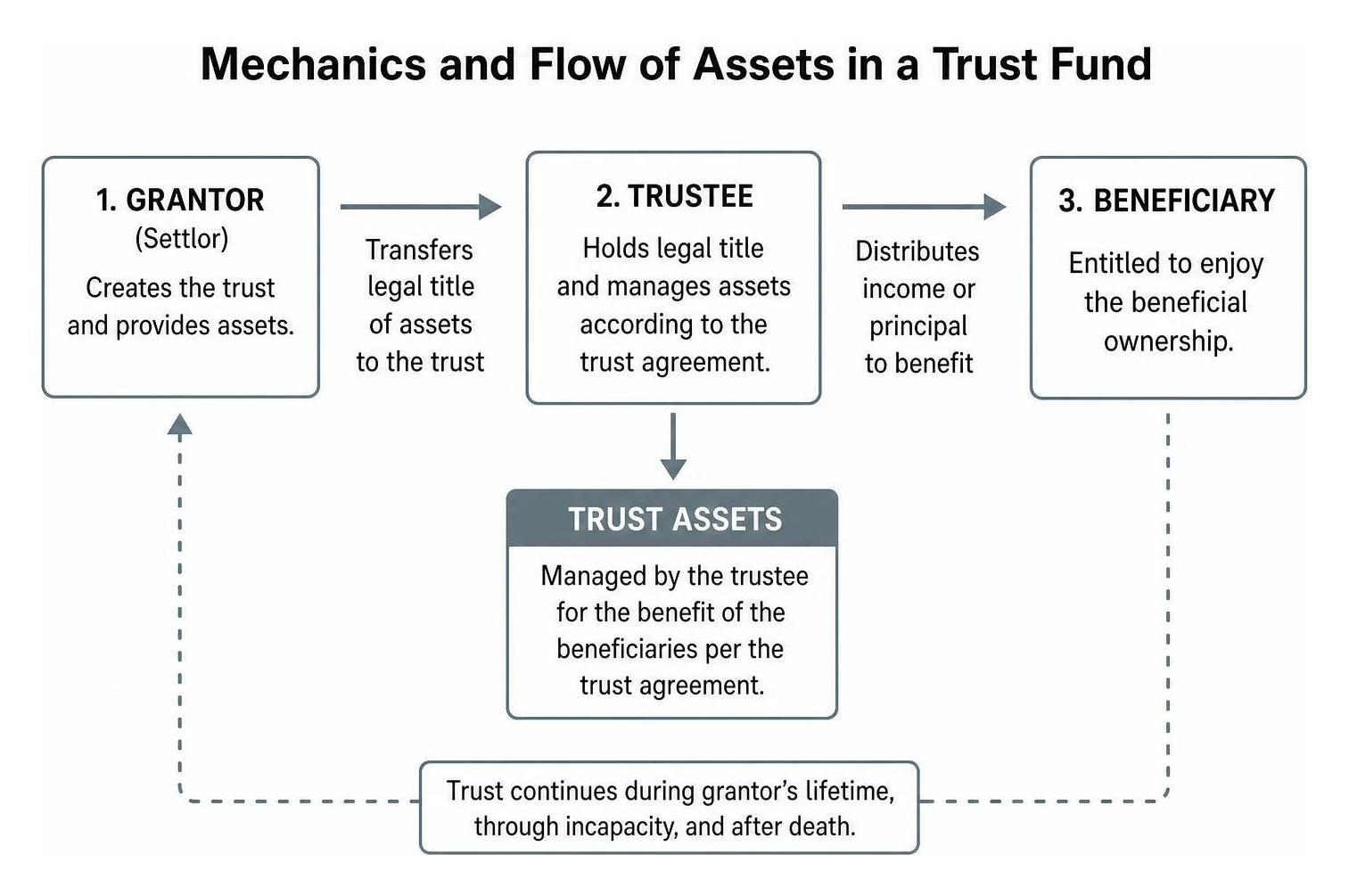
By transferring legal title of your assets to a trust, you preserve your family’s privacy, eliminate unnecessary court delays, and ensure a smooth transition of management if you become ill or injured. This is why so many Arizona families ask, how do you create a trust fund without the legal confusion?
Step-by-Step Guide: How Do You Create a Trust Fund in Arizona
Building a comprehensive estate plan in our state involves adhering strictly to the Arizona Trust Code (A.R.S. Title 14). Knowing how do you create a trust fund correctly requires understanding comprehensive living trust fundamentals so that your assets are properly titled and directed.
Step 1: Choose Your Trust Structure and Define Your Goals
Before drafting paperwork, decide which legal vehicle fits your finances; this is the first answer to how do you create a trust fund that works. The two main categories are revocable living trusts and irrevocable trusts.
| Feature | Revocable Living Trust | Irrevocable Trust |
|---|---|---|
| Grantor Control | Complete control; amend or revoke anytime | Limited/no ability to alter after creation |
| Probate Avoidance | Yes, if funded properly | Yes, for assets transferred into the trust |
| Incapacity Planning | Yes, successor trustee steps in seamlessly | Yes |
| Tax Returns (Lifetime) | Reported under Grantor’s personal SSN | Requires separate EIN & Form 1041 |
| Asset & Creditor Protection | None during your lifetime | May offer creditor protection depending on how it is structured; not guaranteed |
| Medicaid Eligibility | Assets count toward resource limits | May help with eligibility if structured well in advance; look-back rules apply |
For the vast majority of Arizona families, understanding basic revocable trust mechanics is the ideal starting point because it lets you maintain control over your assets while living.
If your goals include protecting a vulnerable family member, you might integrate a spendthrift provision (to keep inherited assets safe from a beneficiary’s future creditors or ex-spouses) or create a special needs trust to provide support without disqualifying a loved one from vital government benefits like Supplemental Security Income (SSI) or Medicaid.
Step 2: Appoint Your Fiduciary and Beneficiaries
Next, decide who manages the trust and who receives its assets. With a revocable living trust, you typically act as your own initial trustee, maintaining 100% control over your daily finances.
However, you must appoint a dependable successor trustee to step in if you become incapacitated or pass away. Your options include:
- Individual Trustees: Adult children, trusted family members, or close friends.
- Corporate Trustees: Professional trust companies or bank trust departments, who act as impartial third parties and charge annual administration fees.
When designating beneficiaries, define how they receive payouts. You can mandate distributions under the HEMS standard (Health, Education, Maintenance, and Support), or schedule staggered distributions (such as releasing portions of principal at ages 25, 30, and 35) to encourage financial maturity.
Step 3: Draft and Execute the Trust Document Under Arizona Law
A valid trust document outlines your specific instructions, the powers of your trustee, and the rules governing asset distributions. To ensure your document satisfies all Arizona revocable living trust statutes, it must be drafted clearly, reflecting your exact legal capacity.
Once your trust agreement is drafted, you sign it as your attorney directs. Arizona does not require a revocable trust to be notarized or witnessed to be valid, but notarization is strongly recommended because financial institutions and title companies often expect it, and a pour-over will requires two witnesses. Helpful overviews on How To Set Up A Trust Fund outline these essential execution steps.
Step 4: Transferring Assets: How Do You Create a Trust Fund Account and Fund It?
When asking how do you create a trust fund, remember that a trust agreement without assets is like a safe with nothing inside. Funding the trust is the critical step that makes your estate plan functional.

Funding requires retitling ownership of your property into the official name of the trust:
- Real Estate: You must execute and record a new deed (the appropriate deed type should be confirmed with your attorney and title company) with the County Recorder’s office in the Arizona county where your property sits (such as Maricopa or Pima County).
- Bank and Brokerage Accounts: Work with your financial institutions to update account titles or open new accounts under your trust’s legal name.
- Personal Property: Assign untitled personal effects and business interests into the trust via an Assignment of Personal Property document.
- Pour-Over Will: Always execute a backup “pour-over will” to catch any accidentally omitted assets and direct them into your trust, reinforcing comprehensive Arizona probate avoidance strategies.
Key Legal Rules, Costs, and Taxes for Arizona Trust Funds
Setting up a trust fund provides stability, but you must factor in administrative costs, tax filing requirements, and statutory rules. At Safeguard Estate and Financial, we work as estate planning professionals alongside qualified legal partners—not as attorneys or a law firm—to help Arizona clients pursue long-term wealth preservation without the stress.
Understanding Setup Costs and Professional Trustee Fees
The financial investment required to build your estate plan depends on the complexity of your family dynamic and asset structure:
- Standard Revocable Living Trust: Costs vary widely by attorney, location, and complexity; ask for a written fee quote.
- Complex Irrevocable Trusts: Sophisticated tax-planning or asset-protection structures generally cost more than a standard revocable trust and vary widely.
- Recording and Notary Fees: Arizona county recorders charge a per-document fee (for example, $30 in Maricopa County), while notary fees are minimal.
- Professional Trustee Fees: If you hire an institutional fiduciary, expect an annual fee, often based on a percentage of trust assets; ask for the fee schedule in writing.
In Arizona, estates valued below the statutory small-estate thresholds under A.R.S. § 14-3971 ($200,000 for personal property and $300,000 for real estate equity) may use simplified transfer affidavits. However, owning a home in Scottsdale or Tucson can push an estate past these thresholds, which is one reason many families consider a living trust.
Tax Rules, Estate Exemptions, and How Do You Create a Trust Fund for Asset Protection?
Taxes on trust funds depend entirely on whether the trust is revocable or irrevocable:
- Revocable Living Trusts: Considered “grantor trusts” by the IRS. You do not need a separate Employer Identification Number (EIN) during your lifetime; all income, deductions, and capital gains flow directly to your personal Form 1040 under your Social Security Number.
- Irrevocable Trusts: These are separate legal entities requiring their own EIN. Income generated by the trust and not distributed to beneficiaries is reported on IRS Form 1041.
- 2026 Federal Exemptions: In 2026, the federal estate tax exemption is $15,000,000 per individual ($30,000,000 for a married couple). The annual gift tax exclusion for 2026 stands at $19,000 per recipient.
- Asset & Benefit Protection: Assets held inside a revocable living trust remain subject to your personal creditors and count toward Medicaid eligibility limits. Irrevocable trusts are sometimes used in planning for liability or long-term care eligibility, but results depend on the trust’s terms, timing (including Medicaid look-back periods), and Arizona and federal law. Consult a licensed attorney before relying on any such strategy.
Still asking how do you create a trust fund for your situation? To learn more about tailored planning for your household, explore our guide on how to set up a family trust in Arizona and take control of your financial legacy today.
This article provides general educational information, not individualized legal, tax, or investment advice. Laws, thresholds, and program rules change, and results depend on your circumstances. Consult appropriately licensed professionals before acting.