 Search

September 25, 2026 • General
Arizona Probate Avoidance Starts With Asset Ownership
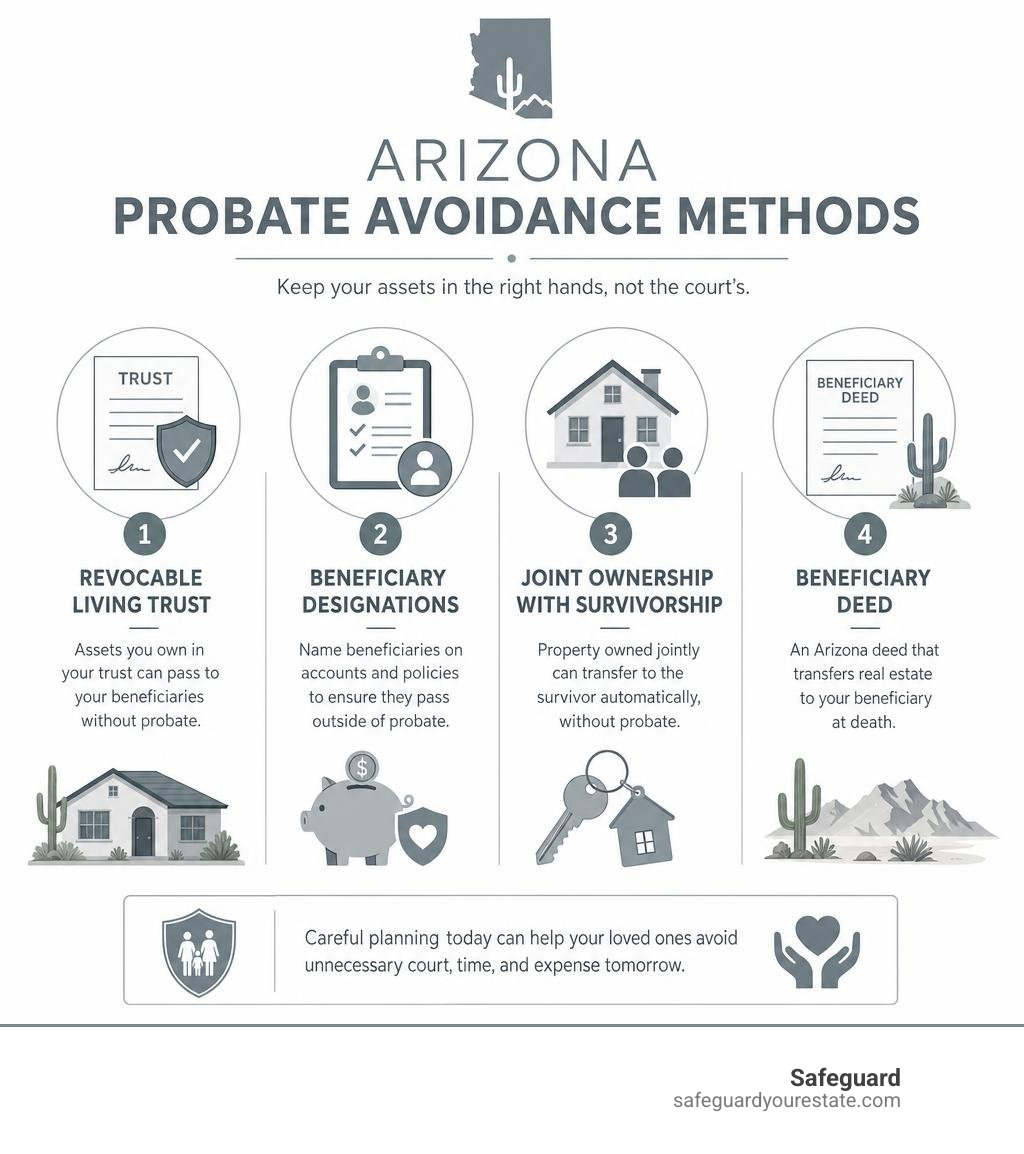
Probate avoidance in Arizona means arranging for assets to transfer at death without a court-supervised probate case. The most common tools are a properly funded revocable living trust, updated beneficiary designations on financial accounts and insurance, joint ownership with survivorship rights, and an Arizona beneficiary deed for real estate. A will is still important, but by itself it does not keep solely owned assets out of probate, so it is not a full probate avoidance plan.
Table of Contents
Probate is the court process used to appoint a personal representative, pay valid debts, and distribute assets under a will or Arizona intestacy law. It can provide helpful oversight, so avoiding it is not always the best choice. The goal of probate avoidance is not to bypass court at all costs, but to create a plan that matches your property, family, privacy needs, and risk of incapacity.
I am Julie Jewett, an Arizona native and estate planning professional who has worked in the field since 2008, helping families understand practical probate avoidance options. At Safeguard Estate and Financial, our estate planning professionals work with legal partners to help clients build clear, coordinated probate avoidance and estate plans for the future.
Introduction to the Probate Process in Arizona

In Arizona, probate is the formal judicial process through which the Superior Court validates a decedent’s will, appoints a personal representative to manage the estate, settles valid creditor claims, and distributes remaining assets to lawful heirs or beneficiaries. While probate serves the essential legal function of clearing title and resolving final affairs, formal court administration can introduce notable administrative burdens.
When solely owned assets enter probate without automated transfer mechanisms, they are subject to statutory court procedures, mandatory notice periods, filing fees, and administrative expenses. Depending on the complexity of the estate, proceedings after a death can cost tens of thousands of dollars in legal and court expenses. Furthermore, all probate filings—including your asset inventory, debts, and the names of your beneficiaries—become public records accessible to anyone. Asset access can also remain temporarily restricted while waiting for the court to issue Letters Testamentary to the personal representative.

Key Strategies for Comprehensive Arizona Probate Avoidance
To bypass court delays and preserve privacy, probate avoidance in Arizona relies on non-probate transfer mechanisms that transfer legal title by operation of law immediately upon death.
| Strategy | Primary Mechanism | Asset Types Handled | Key Advantages |
|---|---|---|---|
| Revocable Living Trust | Fiduciary management via Trust Agreement | Real estate, bank accounts, business interests, personal property | Greater privacy, avoids probate for funded assets, provides incapacity management |
| Beneficiary Deed | A.R.S. § 33-405 statutory recording | Arizona real property | Low cost, owner retains full control during life |
| Joint Tenancy (JTWROS / CPWROS) | Right of survivorship on title | Real estate, joint bank and brokerage accounts | Automatic transfer to surviving co-owner without probate |
| Payable-on-Death (POD) / TOD | Direct contract with financial institution | Bank accounts, CDs, brokerage securities, investment accounts | Simple setup, keeps assets private from probate court |
Revocable Living Trusts as a Foundation for Probate Avoidance

A revocable living trust is a comprehensive vehicle for managing assets and supports probate avoidance for assets properly titled in the trust. When creating a trust, you act as the grantor and typically serve as the initial trustee, maintaining total dominion over your assets during your lifetime. You designate a trusted individual or institution as your successor trustee to take over management upon your incapacity or death.
To understand the core mechanisms, reviewing Revocable Living Trust 101 provides foundational clarity on how these instruments operate. Once established, you must fund the trust by re-titling assets—such as your home deed, bank accounts, and non-retirement investment portfolios—into the name of the trustee of your trust. At Safeguard Estate and Financial, we help guide you through Everything You Need To Know About Living Trusts so no assets are overlooked.
For state-specific statutory protections, explore The Definitive Guide To Arizona Revocable Living Trust Laws and see why Trust Us You Need An Arizona Revocable Trust. Beyond post-death probate avoidance, a trust can help avoid “living probate”—the court-supervised conservatorship or guardianship proceedings required if you become incapacitated. To protect against omitted assets, a pour-over will is drafted alongside the trust, directing any stray assets into the trust structure at death.
Arizona Beneficiary Deeds and Non-Probate Asset Designations
Under Arizona Revised Statutes (A.R.S.) § 33-405, Arizona allows property owners to execute and record a beneficiary deed for real estate. This statutory deed names one or more beneficiaries who will automatically inherit the real estate upon the owner’s death without probate. The owner retains complete lifetime ownership, including the right to sell, refinance, or revoke the deed. To be legally effective, the beneficiary deed must be executed and recorded in the county where the property is located prior to the transferor’s death.
For liquid and investment assets, direct beneficiary designations are simple probate avoidance tools that provide seamless title transfers:
- Payable-on-Death (POD) Accounts: Bank checking, savings, and certificate of deposit (CD) accounts transfer directly to named payees upon presenting a certified death certificate.
- Transfer-on-Death (TOD) Registrations: Brokerage accounts, individual stocks, and mutual funds transfer ownership directly to designated survivors.
- Joint Tenancy with Right of Survivorship (JTWROS): Property automatically vests in the surviving joint owner.
- Community Property with Right of Survivorship (CPWROS): For Arizona married couples, this titling provides automatic survivorship rights while delivering a full double step-up in income tax basis under federal tax rules.
- Uniform Transfers to Minors Act (UTMA): In Arizona, custodial designations for minor beneficiaries manage assets privately until the minor reaches age 21.
Common Misconceptions and Risks in DIY Probate Avoidance
Probate avoidance without careful coordination can lead to unintended consequences:
- Loss of Creditor Bar Periods: The formal probate process establishes a strict statutory creditor claim window that cuts off unknown claims after four months. Completely avoiding probate means general statutes of limitations apply, potentially leaving heirs vulnerable to delayed creditor claims.
- Conflicting Estate Documents: Naming a beneficiary directly on a bank account overrides any contrary distribution instructions written in a will. If you need a refresher on harmonizing documents, read How To Create A Will In Arizona Without Losing Your Mind.
- Divorce and Property Settlements: A marital settlement agreement awarding an account to one spouse does not automatically change a bank’s internal POD paperwork; failure to file updated forms can result in ex-spouses legally receiving assets.
- Estate Illiquidity: If all liquid cash passes directly to specific individuals via POD designations, the estate may lack liquid funds to pay property taxes, utility bills, or funeral expenses.
Arizona Small Estate Affidavits and Statutory Limits Under A.R.S. § 14-3971
When an individual passes away with solely owned probate property in Arizona, formal court probate may still be avoided if the estate qualifies under the statutory thresholds of A.R.S. § 14-3971:
- Personal Property Affidavit: If the net value of all personal property in the probate estate does not exceed $200,000 (after deducting liens and encumbrances), an eligible successor can claim the assets using an affidavit. A strict 30-day waiting period from the date of death is required before submitting this affidavit.
- Real Property Affidavit: If the net equity of Arizona real property does not exceed $300,000, title can be transferred via a small estate affidavit. A mandatory six-month waiting period from the date of death must elapse before filing this instrument with the probate court clerk.
If assets exceed these statutory limits and lack trust funding or beneficiary designations, the estate must undergo Arizona informal or formal probate administration.
High-Net-Worth Wealth Preservation and 2026 Exemption Rules
For individuals with substantial estates, probate avoidance must be integrated with advanced transfer tax planning. As of 2026, every U.S. taxpayer is granted a federal unified gift and estate tax exemption set at $15 million per person (indexed for inflation), with a separate Generation-Skipping Transfer (GST) tax exemption also set at $15 million per person.
Transfers to grandchildren or later generations in excess of the exemption trigger the federal GST tax, which is assessed at a flat 40% rate. Unlike the basic estate tax exemption, the GST tax exemption is non-portable between spouses; if unused by the first-to-die spouse, it is permanently lost.
To safeguard multigenerational wealth, families pair probate avoidance with sophisticated trust architectures such as dynasty trusts and Intentionally Defective Grantor Trusts (IDGTs). By selling appreciating family business or real estate interests to an IDGT in exchange for a promissory note, future appreciation may be excluded from the taxable estate when properly structured. These strategies carry complex income, gift, estate, and valuation consequences and require individualized review by qualified tax and legal advisers. For an in-depth analysis of advanced structures, review multigenerational wealth transfer with IDGTs and GST tax planning. You can also learn the practical setup steps in How To Set Up Family Trust Arizona.
Implementing a Secure Long-Term Estate Plan
Probate avoidance should never be viewed as an isolated paperwork exercise. It requires an aligned, comprehensive strategy that secures your family’s financial legacy, prevents court entanglements, and protects your assets in the event of unexpected incapacity. Discover Why Estate Planning Is Important when safeguarding your household’s future.
At Safeguard Estate and Financial, we are estate planning professionals who work hand-in-hand with qualified legal partners to help families coordinate personalized estate planning and trust documents prepared by licensed attorneys. We help you organize how your real estate, bank accounts, and investments are titled, with legal questions reviewed by qualified counsel.
Schedule your Estate Planning Consultation today or visit our Probate Avoidance service page to design a customized plan for lasting security and peace of mind.
This article provides general educational information, not individualized legal, tax, or investment advice. Laws, thresholds, and program rules change, and results depend on your circumstances. Consult appropriately licensed professionals before acting.