 Search

September 25, 2026 • General
Understanding Different Pension Types and Lifetime Income
The main different pension types are defined benefit plans, defined contribution plans, and hybrid options such as cash balance plans. Defined benefit plans promise a set retirement benefit, while defined contribution plans build an account balance based on contributions and investment results. Social Security and personal retirement accounts can add other income sources.
Table of Contents
The right mix depends on how much guaranteed income you need, how much investment risk you can accept, and how your retirement assets fit into your Arizona estate plan. Safeguard Estate and Financial helps families consider these choices alongside their broader planning needs; its estate planning professionals work with legal partners and are not lawyers or attorneys.
I am Julie Jewett, Principal and Director of Operations, and I have worked in estate planning since 2008, helping Arizona families protect assets and plan with greater clarity. Understanding different pension types is an important part of making sure retirement savings, beneficiary choices, and family goals work together.
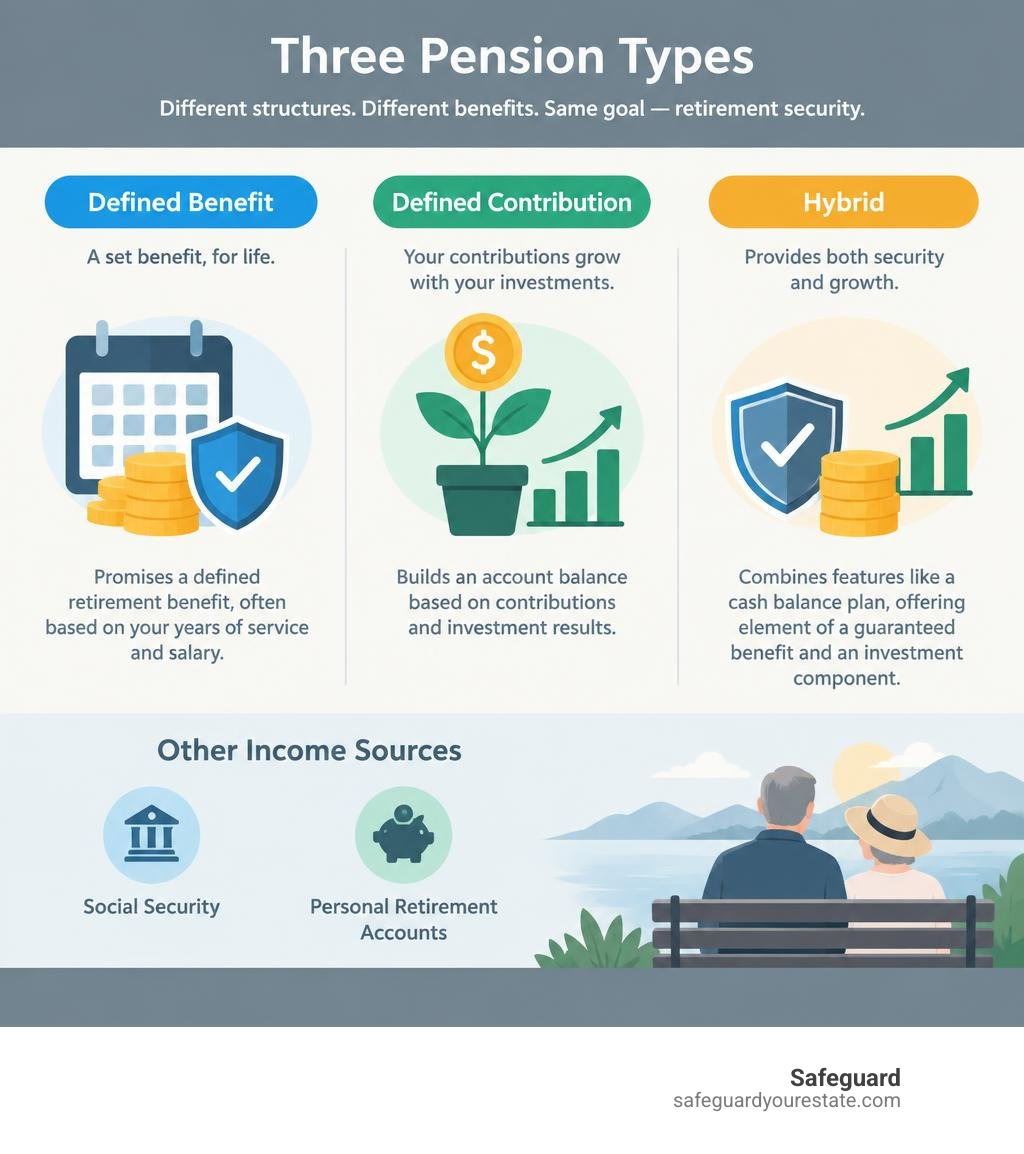
Core Structures and Different Pension Types Explained
Navigating retirement security begins with understanding how the different pension types accumulate funds and pay them out. The Types of Retirement Plans | U.S. Department of Labor framework establishes distinct regulatory boundaries, protections, and funding obligations for employer-sponsored retirement options.
Whether you are evaluating a traditional lifetime annuity, managing an individual investment portfolio, or reviewing public-sector retirement benefits, each structure allocates investment risk, administrative responsibility, and payout guarantees differently.
| Plan Category | Primary Risk Bearer | Benefit Calculation Basis | Core Feature |
|---|---|---|---|
| Defined Benefit | Employer / Plan Sponsor | Formula (Salary, Years of Service) | Guaranteed monthly lifetime income |
| Defined Contribution | Employee / Participant | Contributions + Market Performance | Account balance flexibility, portable funds |
| Hybrid (Cash Balance) | Employer / Plan Sponsor | Pay Credits + Stated Interest Credits | Hypothetical account balance with fixed growth |
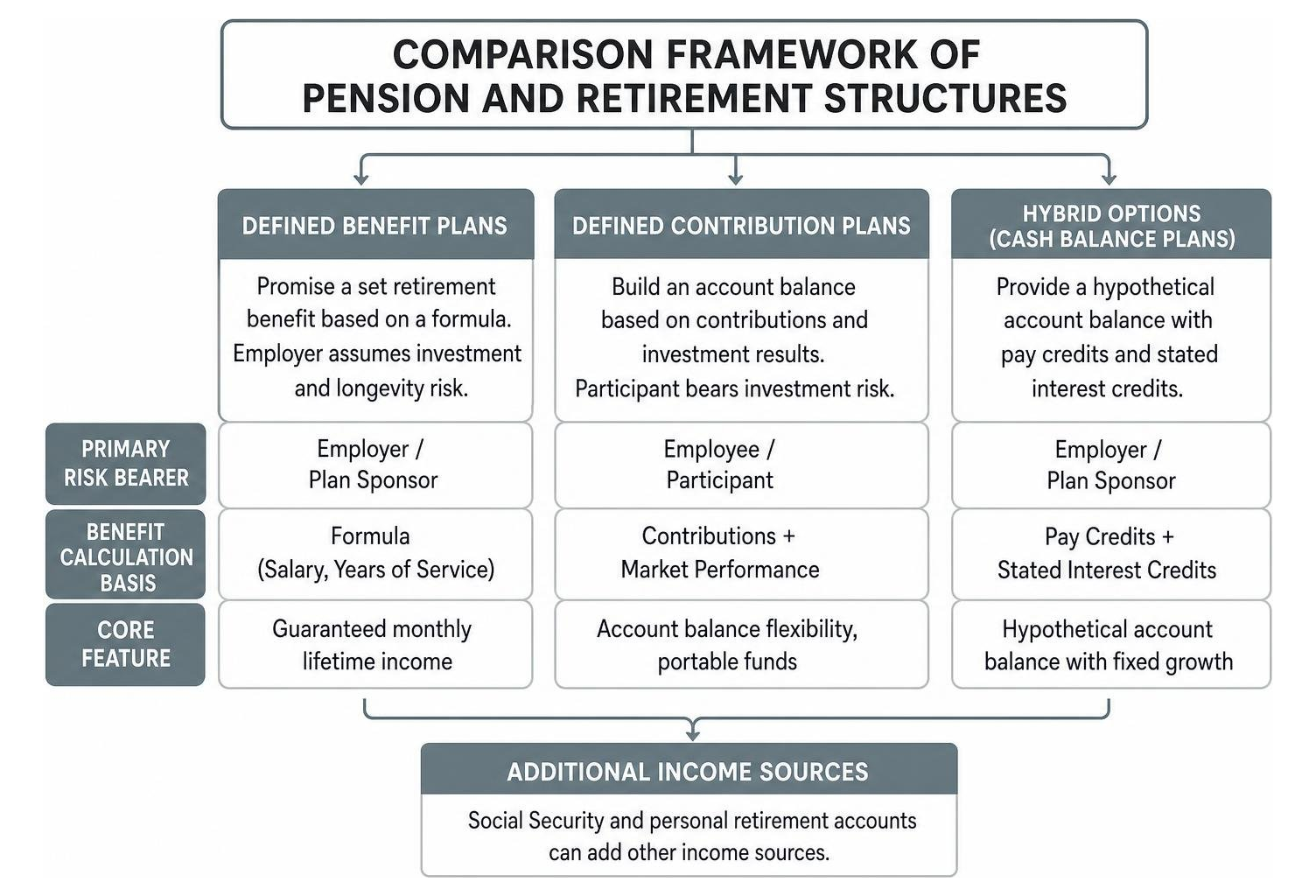
Defined Benefit vs. Defined Contribution: Two Main Different Pension Types
Of all the different pension types, the two primary categories shaping modern retirement are defined benefit and defined contribution plans.
Under a defined benefit plan, the employer guarantees a specific monthly payout upon retirement. This figure is calculated using an accrual formula based on your final average earnings or career-average compensation combined with total years of service. Because the employer assumes all investment and longevity risk, they must ensure adequate plan funding regardless of market swings.
In contrast, defined contribution plans—such as standard 401(k), 403(b), and profit-sharing arrangements outlined in the Types of retirement plans | Internal Revenue Service guidelines—place the investment choices and market risk squarely on the worker. Contributions accumulate over time, and your final nest egg reflects market gains or losses.
Hybrid models like cash balance plans combine elements of both: the employer defines the promised benefit as a hypothetical account balance, providing annual pay credits alongside fixed or index-linked interest credits.
Workplace and Individual Retirement Options Across Different Pension Types
Workplace plans are among the different pension types that form the backbone of many retirement portfolios. Employers often incentivize participation by matching a portion of worker contributions, providing immediate return on investment.
For professionals seeking enhanced autonomy or tax efficiency, individual retirement accounts (IRAs), SEP IRAs, and Solo 401(k)s offer broader asset selection, ranging from equities and index funds to specialized assets. Integrating these workplace vehicles with comprehensive wealth preservation strategies ensures that contributions maximize allowable tax deductions while shielding accumulated capital from unnecessary erosion over time.
Federal Social Security and Arizona Public-Sector Retirement Benefits
For Arizona workers, public benefits work alongside personal savings and the different pension types described above. Federal Social Security serves as a foundational floor, calculated on lifetime earnings and lifetime qualifying work credits. Maximizing this stream often involves evaluating your claim timing; deferring benefits beyond your initial eligibility age yields permanent annual benefit increases up to age 70.
Across our state—from Tucson to Scottsdale and Oro Valley—many individuals also participate in public retirement programs such as the Arizona State Retirement System (ASRS) or the Public Safety Personnel Retirement System (PSPRS). These defined benefit systems deliver reliable, lifetime monthly annuities based on specific membership tiers and service credits. Our dedicated retirement planning services help clients coordinate these state pensions with federal benefits to establish a reliable cash-flow baseline.
Handling Job Changes, Multiple Accounts, and Lost Pension Tracing
Changing employers throughout your career can leave a trail of scattered accounts from different pension types. When transitioning between roles, you generally have several options:
- Maintain your vested balance in the former employer’s plan (if permitted).
- Roll over the accumulated funds into your new employer’s qualified plan.
- Consolidate legacy balances into a self-directed rollover IRA for unified portfolio management.
Neglecting old accounts can lead to lost savings over time. If you suspect you have orphaned accounts with previous employers, national tracing registries and plan administrator records can help locate forgotten funds. For residents navigating these transitions, local Tucson retirement planning guidance ensures that rollovers avoid triggering immediate taxable distributions or penalty events.
Protecting and Integrating Pension Wealth in Arizona
Building a retirement stream is only half the battle; protecting it from probate delays, excessive taxation, and unintended distribution is equally critical. In Arizona, pension payouts and qualified account balances do not automatically pass under standard wills if primary and contingent beneficiary designations are outdated or uncoordinated.

Relying solely on default beneficiary forms can expose retirement wealth to unnecessary vulnerabilities. Coordinating your qualified assets with structured retirement asset protection in Tucson and across Arizona can help you understand how creditor-protection rules apply to retirement accounts, coordinate generational wealth transfers, and reduce the chance of disputes for your heirs.
Aligning Pension Distributions with Arizona Estate Planning
Achieving true financial peace of mind requires harmonizing payouts from different pension types with a comprehensive revocable living trust. When structured properly under Arizona law, a trust-centered estate plan can help ensure that non-probate transfers, required minimum distributions, and survivor benefits pass efficiently to your intended beneficiaries while avoiding the public, court-supervised Arizona probate process.
For smaller estates, Arizona statutes provide simplified transfers via personal property affidavits under A.R.S. § 14-3971 (currently up to $200,000 for personal property, though thresholds can change), but a coordinated, trust-based plan is often considered for more comprehensive asset integration. At Safeguard Estate and Financial, our estate planning professionals work closely with qualified legal partners—we are not lawyers or attorneys, but experienced planners dedicated to making complex processes clear and actionable.
By understanding why estate planning is important, you can safeguard your lifetime income, protect your family’s legacy, and align your retirement benefits with your long-term goals. Connect with the team at Safeguard Estate and Financial to build an integrated estate and retirement roadmap tailored to your family’s future.
This article provides general educational information, not individualized legal, tax, or investment advice. Laws, thresholds, and program rules change, and results depend on your circumstances. Consult appropriately licensed professionals before acting.