 Search

August 10, 2026 • General
Why Understanding Arizona ALTCS Eligibility Requirements is Your First Step to Peace of Mind
Table of Contents
Figuring out the arizona altcs eligibility requirements can feel like trying to read a map in a desert storm, but knowing these rules is the key to protecting your hard-earned savings. The Arizona Long Term Care System (ALTCS) is a state Medicaid program. It pays for long-term care at home, in assisted living, or in a nursing home so you do not have to pay out of pocket.
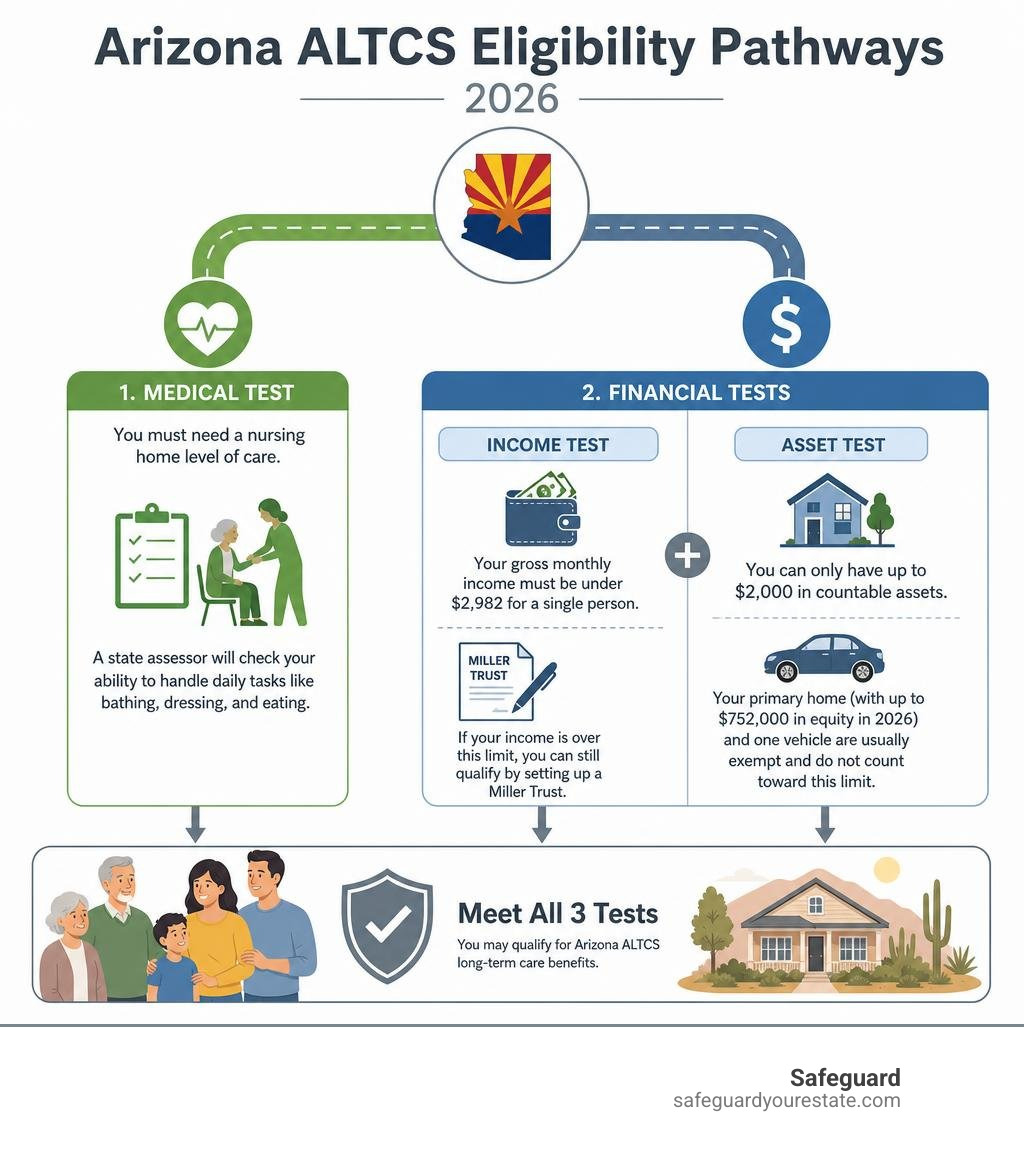
To qualify for ALTCS in 2026, you must meet three basic tests:
- The Medical Test: You must need a nursing home level of care. A state assessor will check your ability to handle daily tasks like bathing, dressing, and eating.
- The Income Test: Your gross monthly income must be under $2,982 for a single person. If your income is over this limit, you can still qualify by setting up a special legal tool called a Miller Trust.
- The Asset Test: You can only have up to $2,000 in countable assets. Your primary home (with up to $752,000 in equity in 2026) and one vehicle are usually exempt and do not count toward this limit.
If you are worried about losing your home or draining your bank account to pay for care, you do not have to go through this alone.
I am Julie Jewett, Principal and Director of Operations at Safeguard Estate and Financial, where we serve as estate planning professionals alongside our legal partners to help you protect what matters most. Since 2008, I have helped Arizona families master the complex arizona altcs eligibility requirements to preserve their wealth and achieve total peace of mind.
Navigating the Arizona ALTCS Eligibility Requirements
When a loved one begins to need extra help, the emotional toll is heavy enough. Adding the stress of financial planning can make it feel completely overwhelming. Fortunately, the ALTCS: Coverage for Individuals with Long-Term Care Needs program is designed to provide robust long-term care benefits.
Unlike standard Medicare, which only covers short-term rehabilitation (up to 100 days), Arizona Medicaid (administered through AHCCCS) is built to cover ongoing custodial care. Whether your goal is to transition to a comfortable assisted living community or receive direct care in the comfort of your own home, proper Estate Planning is the ultimate key to locking in these benefits without spending down everything you own.
Medical Criteria: Meeting the Arizona ALTCS Eligibility Requirements
Before the state looks at your bank accounts, they must determine if you actually need the level of care ALTCS provides. This is determined through a clinical evaluation called the Pre-Admission Screening (PAS).
During the PAS, an ALTCS social worker or nurse will interview the applicant and review their medical records to calculate a numerical PAS score. To qualify medically, the applicant must meet the following criteria:
- Activities of Daily Living (ADLs): The assessor scores how much hands-on assistance the applicant needs with basic tasks, including bathing, dressing, grooming, eating, toileting, and mobility.
- Cognitive Impairment: Individuals suffering from Alzheimer’s disease, dementia, Parkinson’s, or other cognitive disorders may qualify even if they are physically strong, as they require constant supervision to remain safe.
- Physician Certification: All reported medical symptoms, physical disabilities, and cognitive limitations must be backed by official medical records and physician certifications.
Financial Criteria: Income Limits and Miller Trusts
The financial side of the arizona altcs eligibility requirements is where many families run into roadblocks. Arizona is an “income cap” state. This means if your gross monthly income is even one dollar over the limit, you are technically disqualified—unless you have the right legal structures in place.
For 2026, the gross monthly income limits are strictly defined:
- Single Applicant: $2,982 per month.
- Married Couples (Applying Together): $5,964 per month.
Gross income means the total amount before deductions for Medicare Part B premiums, taxes, or health insurance are taken out.
What If Your Income Exceeds the Limit?
If your gross monthly income exceeds $2,982, we can help you establish a Miller Trust (also known as an Income-Only Trust). By routing your excess income through this trust, ALTCS legally disregards the excess amount, allowing you to qualify. This trust includes a state payback provision, meaning any remaining funds in the trust upon the beneficiary’s passing go to the state to offset the cost of care provided.
The Difficulty of Care Exclusion
If you are a live-in family caregiver providing personal or attendant care to an ALTCS member in your shared home, your caregiving wages are classified as “Difficulty of Care” payments. Under Arizona rules, this income is excluded from Medicaid eligibility calculations. However, electronic state verification systems often fail to recognize this exemption automatically, leading to wrongful denials. If this happens, we recommend manually reporting the exclusion to keep your eligibility intact.
| Financial Metric | 2025 Limit | 2026 Limit |
|---|---|---|
| Single Applicant Income Cap | $2,901 / month | $2,982 / month |
| Married Combined Income Cap | $5,802 / month | $5,964 / month |
| Countable Asset Limit (Single) | $2,000 | $2,000 |
| Primary Home Equity Limit | $730,000 | $752,000 |
| Max Community Spouse Resource Allowance | $157,920 | $162,660 |
Resource Limits: Countable vs. Exempt Assets

To qualify for ALTCS, a single applicant must have no more than $2,000 in countable resources. Countable assets include checking and savings accounts, stocks, bonds, mutual funds, certificates of deposit (CDs), and real estate other than your primary home.
Fortunately, Arizona law allows for several highly valuable exempt (non-countable) assets, which do not count toward that $2,000 limit:
- Primary Residence: Your home is exempt if you intend to return to it, or if your spouse or a disabled child lives there. In 2026, the home equity limit for this exemption is $752,000.
- One Vehicle: One automobile of any value is completely excluded if it is used for the applicant’s transportation or medical care.
- Household Goods & Personal Effects: Furniture, appliances, clothing, and jewelry are exempt.
- Burial Funds: You can set aside up to $1,500 in a designated burial fund or purchase an irrevocable prepaid funeral plan of any reasonable value.
Understanding how these assets are categorized under Ariz. Admin. Code § R9-28-407 – Resource Criteria for Eligibility is vital. Many families mistakenly believe they have to sell their homes or spend down all their savings before applying. By learning Everything You Need to Know About Living Trusts, you can find legal, strategic ways to protect your assets while meeting state requirements.
Spousal Protections and the 60-Month Look-Back Period
If you are married and only one spouse needs long-term care, the state provides robust spousal impoverishment protections so the healthy spouse (the “community spouse”) isn’t left penniless.
- Community Spouse Resource Allowance (CSRA): In 2026, the healthy spouse can keep a minimum of $32,532 and up to a maximum of $162,660 in joint countable resources, depending on their total asset snapshot.
- Minimum Monthly Maintenance Needs Allowance (MMMNA): If the healthy spouse’s individual income is low, they are allowed to keep a portion of the applicant spouse’s income, ranging from $2,643.75 to a maximum of $4,066.50 per month.
The 60-Month Look-Back Period
You cannot simply give away your money to family members to drop under the $2,000 asset limit. ALTCS enforces a strict 60-month (5-year) look-back period on all asset transfers. Any gifts, transfers, or sales of property for less than fair market value during this window will trigger a penalty period during which ALTCS will refuse to pay for care.
The penalty is calculated by dividing the total amount gifted by the county-specific private pay rate. In 2026, the private pay rate used for Maricopa, Pima, and Pinal Counties is $8,666.72 per month (and $8,132.22 for all other Arizona counties).
For example, gifting $86,667 to a child within the look-back window would result in a 10-month penalty period where you must pay out of pocket for care. Working on proactive Wealth Preservation strategies is the best way to navigate these rules safely.
Pediatric Care: The HCBS Needs Tool and Extraordinary Care Review
Understanding the Arizona ALTCS eligibility requirements for children matters too. ALTCS is not just for seniors — it also provides life-changing Home and Community Based Services (HCBS) for minor children diagnosed with developmental disabilities, such as autism or cerebral palsy.
For minor applicants, parental income and assets are completely excluded from the financial eligibility calculation; only assets registered directly in the child’s name are evaluated.
Navigating the HCBS Needs Tool (HNT)
To determine how many hours of in-home care or habilitation services a child receives, ALTCS utilizes the HCBS Needs Tool (HNT). Following community feedback, the state paused the HNT for children under 18 and is implementing revised rules through October 10, 2026. These updates lower several age thresholds (for example, assessing self-care tasks like bathing and grooming starting at age 5 instead of age 8) and cap standard habilitation hours at 14 hours per week.
The Extraordinary Care Review (ECR)
If your child has complex, round-the-clock medical or behavioral needs that exceed standard HNT caps, you can request an Extraordinary Care Review (ECR). This exception process allows families to document and secure additional direct care hours beyond standard limits.
How to Apply and Avoid Common Denials under Arizona ALTCS Eligibility Requirements
Meeting the Arizona ALTCS eligibility requirements is only half the process. By administrative rule, the state aims to render an eligibility decision within a 45-day window from the date the application is officially received, though in practice the full process — including gathering documentation and any follow-up requests — can take longer.
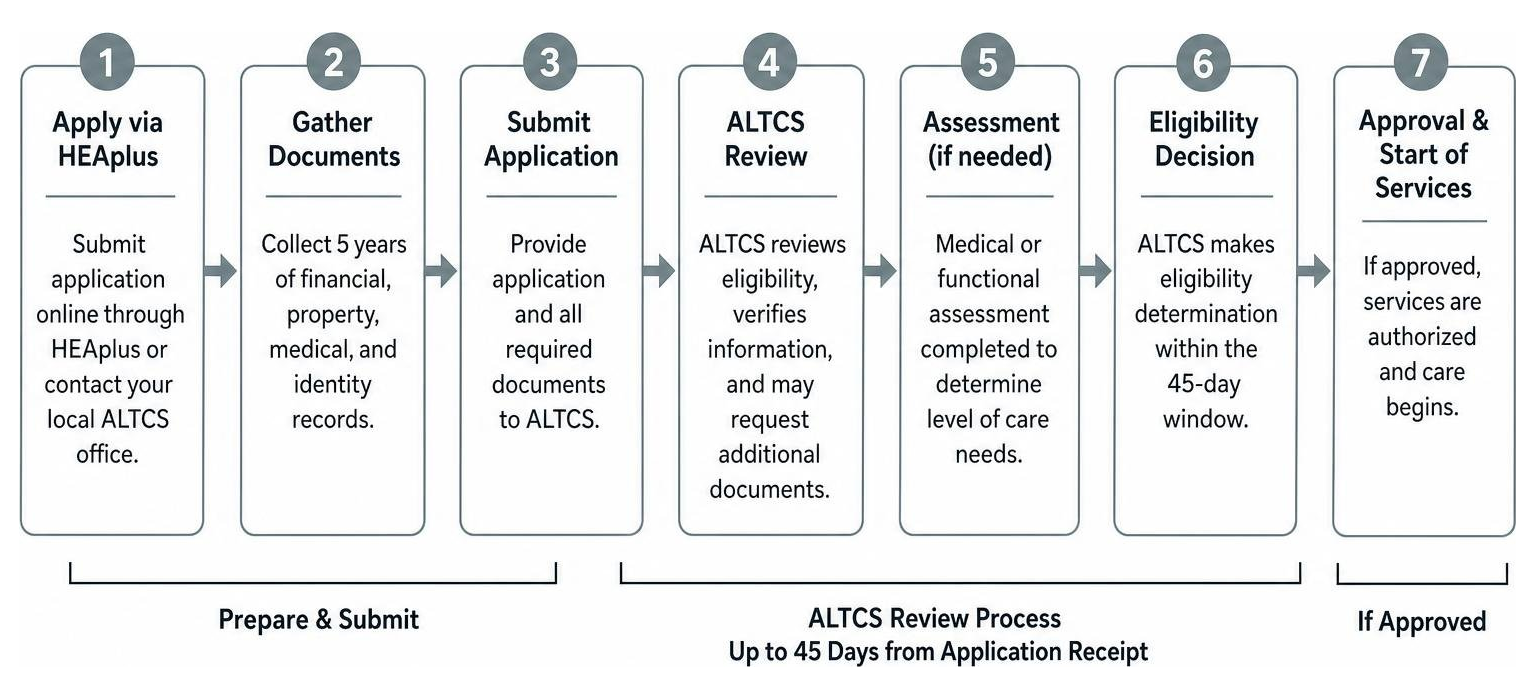
To avoid common denials—such as failing the asset test, submitting incomplete bank records, or triggering look-back transfer penalties—it is crucial to prepare thoroughly:
- Apply via HEAplus: You can initiate and submit your application online through the Health-e-Arizona Plus portal or by calling your local ALTCS office.
- Organize Five Years of Records: Gather bank statements, home deeds, vehicle titles, tax returns, and medical records dated within the exact month of your application.
- Protect Your Home with a Beneficiary Deed: While ALTCS cannot force you to sell your home during your lifetime, the state can file a TEFRA lien or seek estate recovery after your passing to recoup care costs. Because estate recovery in Arizona generally targets assets that pass through probate, recording an Arizona Beneficiary Deed can be one way to transfer your home directly to your heirs outside of probate. Whether this fully protects a home from estate recovery depends on the specifics of your situation, so this should be reviewed with your estate planning team before you rely on it.
Conclusion: Secure Your Future with Safeguard Estate and Financial
Navigating the arizona altcs eligibility requirements does not have to be a lonely or stressful journey. At Safeguard Estate and Financial, we specialize in helping families in Scottsdale, Oro Valley, and Tucson protect their hard-earned assets while securing the high-quality care they deserve.
As experienced estate planning professionals working with dedicated legal partners, we can design custom living trusts, guide you through strategic spend-downs, and align your plans perfectly with Arizona law.
Let us help you achieve true peace of mind. More info about Safeguard services is just a click away—reach out to us today to schedule your consultation!