 Search

October 15, 2026 • General
Retirement Income Planning Turns Savings Into a Lasting Paycheck
Retirement income planning helps you turn savings, Social Security, pensions, and investments into cash flow that can last for life. Start by listing essential monthly costs, such as housing, food, insurance, taxes, and health care. Then match as much of that baseline as possible with reliable income, including Social Security, a pension, or an appropriate lifetime annuity. Use your portfolio for flexible spending, inflation protection, and unexpected costs.
A useful plan also sets a realistic withdrawal rate, coordinates taxes across taxable, traditional, and Roth accounts, and keeps a cash reserve so you are not forced to sell investments after a market drop. This matters because retirement may last 30 years or longer, and a 65-year-old couple has a meaningful chance that one spouse will live past age 90.
I am Julie Jewett, a Principal, Estate Planning Professional, and Director of Operations with experience in estate planning since 2008. At Safeguard Estate and Financial, our estate planning professionals work with legal partners, rather than serving as lawyers or attorneys, to help Arizona families connect retirement income planning with plans to protect their assets and loved ones.
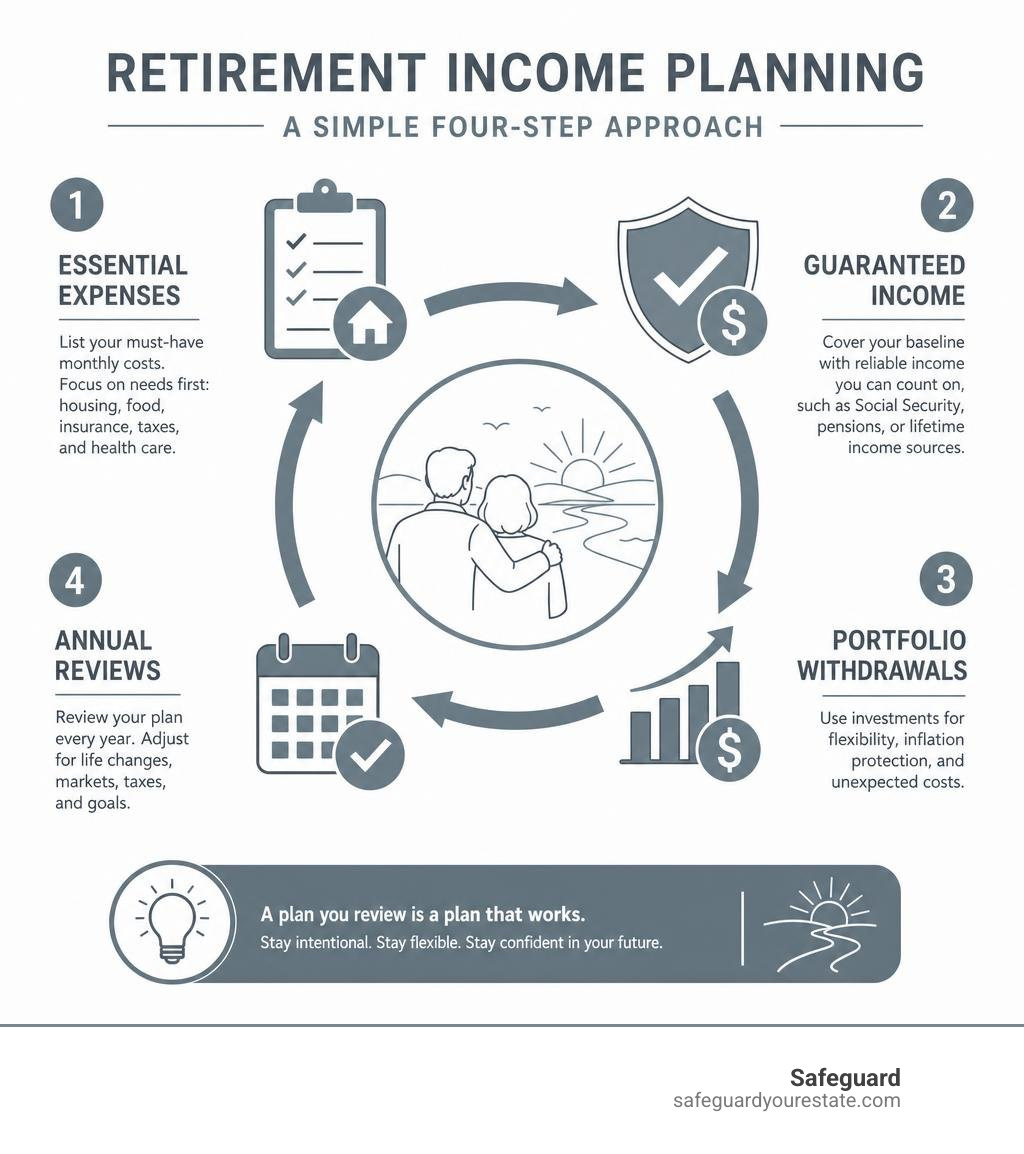
Core Pillars of Retirement Income Planning
Transitioning from asset accumulation to lifetime distribution requires a structured approach. Historically, financial planning benchmarks suggested replacing 70% to 80% of pre-retirement earnings. In practice, many retirees require 80% to 90%—or even closer to 100% during active early years—to maintain their standard of living.
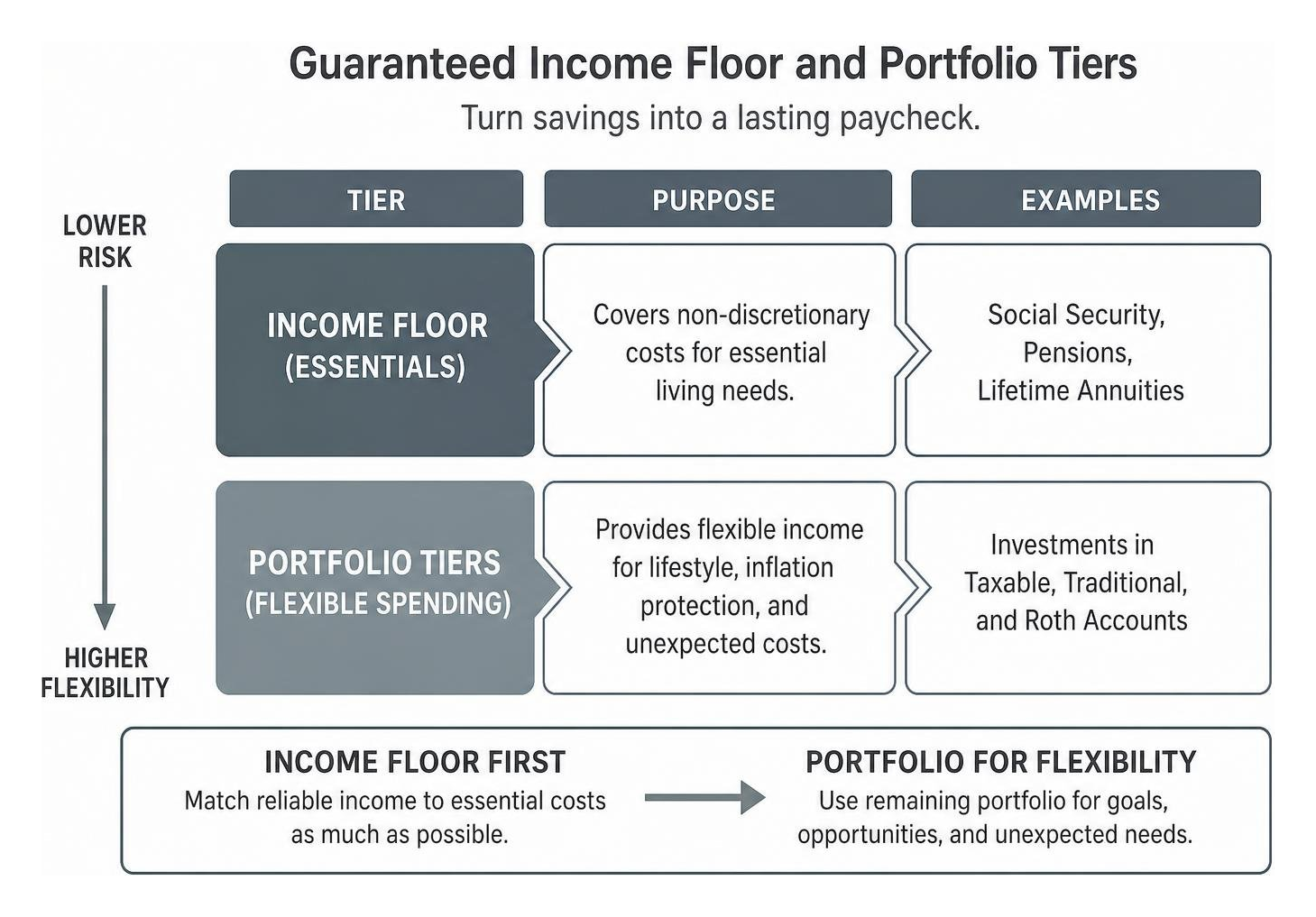
A functional strategy categorizes spending into non-negotiable essentials and flexible discretionary lifestyle expenses. Establishing this division allows for comprehensive retirement planning that aligns reliable cash flows with baseline survival needs while letting growth-oriented investments fund travel and hobbies.
Establishing an Income Floor in Retirement Income Planning
An income floor consists of guaranteed income streams designed to cover non-discretionary costs: mortgage or rent, property taxes, utilities, groceries, and basic healthcare. On average, Social Security retirement benefits replace roughly 40% of pre-retirement income, leaving an income gap that personal assets must support.
To build an airtight floor, retirees combine defined benefit pensions, Social Security, and fixed income instruments such as Single Premium Immediate Annuities (SPIAs) or fixed index annuities. According to the Retirement Planning Guide: How to Plan for Retirement (2026), adopting a “floor and upside” framework ensures basic living costs remain insulated from stock market fluctuations.
Social Security Optimization and Timing Strategies
Claiming Social Security is one of the highest-value decisions in your plan. In 2026, the average monthly benefit for an individual is approximately $1,907. While benefits can be claimed as early as age 62, doing so permanently reduces the payout by up to 30% compared to a Full Retirement Age (FRA) of 67.
Delaying benefits beyond FRA earns an 8% delayed retirement credit per year up to age 70. Claiming at age 70 yields a monthly benefit up to 76% higher than claiming at 62.
| Claiming Age | Percentage of Full Retirement Age (67) Benefit | Estimated Monthly Payout (Based on $1,907 Baseline) | Strategic Considerations |
|---|---|---|---|
| Age 62 | 70% | ~$1,335 | Early access, permanent lifetime reduction, subject to earnings test limits if still working |
| Age 67 (FRA) | 100% | ~$1,907 | Full baseline benefit for those born in 1960 or later, no earnings test penalties |
| Age 70 | 124% | ~$2,365 | Maximum guaranteed payout, optimal longevity hedge, maximizes spousal survivor benefits |
For married couples, coordinating claims so the higher-earning spouse delays until age 70 provides essential longevity protection and maximizes the lifetime benefit available to the surviving partner.
Safe Withdrawal Rates and Sequence-of-Returns Protection
Portfolio distributions fund expenses beyond your guaranteed floor. The 4% rule, derived from William Bengen’s research and the Trinity Study, suggests withdrawing 4% of your initial portfolio value in year one and adjusting subsequent annual distributions for inflation. On a $1,000,000 portfolio, this provides $40,000 annually.
However, static withdrawal rules can be vulnerable to sequence-of-returns risk—experiencing a severe market downturn during the first three to five years of decumulation. When you liquidate depreciated assets to meet living expenses, portfolio recovery is permanently impaired.
To enhance wealth preservation, retirees use two practical shields:
- Cash Reserve Buffers: Maintaining 12 to 24 months of living expenses in liquid cash reserves prevents forced asset sales during market corrections.
- The Bond Tent Strategy: Overweighting fixed income assets right at the retirement transition and gradually re-expanding equities over time insulates against early drawdowns while preserving long-term purchasing power.
Optimizing Lifetime Cash Flow and Arizona Asset Preservation
Generating sustainable income requires managing taxes, state-specific rules, and estate governance. In 2026, integrating tax-efficient distribution order with asset protection ensures wealth transfers smoothly to heirs without unnecessary court intervention.

An annual decumulation audit includes:
- Reviewing marginal tax brackets before taking discretionary distributions
- Calculating Required Minimum Distribution (RMD) obligations across all traditional accounts
- Inspecting revocable living trust asset titling and primary beneficiary alignments
- Verifying cash buffers and rebalancing equity allocations
Tax-Efficient Account Drawdowns and RMD Management
From the correct account types preserves portfolio capital over decades. The standard tax-efficient withdrawal sequence generally follows:
- Required Minimum Distributions (RMDs): SECURE 2.0 mandates RMDs from traditional IRAs and 401(k)s starting at age 73. Because RMDs are fully taxable as ordinary income, they must be satisfied first.
- Taxable Brokerage Accounts: Assets drawing capital gains rates rather than ordinary income rates come next, allowing qualified dividends and capital gains treatment.
- Traditional Tax-Deferred Accounts: Withdrawing from traditional accounts fills lower income tax brackets up to strategic thresholds.
- Roth Accounts: Roth IRAs grow and distribute 100% tax-free. Leaving these accounts for last maximizes tax-free compounding and creates a tax-sheltered legacy for heirs.
Retirees can also implement partial Roth conversion ladders between their retirement date and age 73 to systematically shrink traditional IRA balances at lower tax rates. Additionally, individuals age 70½ or older can utilize Qualified Charitable Distributions (QCDs) up to $105,000 annually to satisfy RMD obligations directly to charity without increasing adjusted gross income.
Integrating Healthcare, Long-Term Care, and Arizona Estate Planning
Healthcare remains one of the largest retirement liabilities. Fidelity estimates that an average 65-year-old couple retiring in 2026 will spend roughly $315,000 on medical expenses throughout retirement, excluding long-term care. Medicare Parts B and D require proactive premium planning to avoid Income-Related Monthly Adjustment Amounts (IRMAA) triggered by sharp RMD spikes.
For long-term care, hybrid life and long-term care policies protect personal assets from catastrophic medical spend-downs. Aligning these resources with localized estate planning is essential in Arizona.
Arizona offers a favorable tax environment, fully exempting Social Security benefits from state income taxation and providing stable property tax structures. For localized asset safeguarding, explore retirement asset protection in Tucson to coordinate legal instruments with distribution timing. Consult official guidelines from the Retirement | AZ Treasury Office – Arizona State Treasurer for regional insights.
Sound decumulation must be coupled with rigorous estate planning. While Arizona provides small-estate affidavit processes under A.R.S. § 14-3971—allowing simplified transfers for estates with personal property valued at $75,000 or less and real property equity at $100,000 or less—most homeowners in Scottsdale, Tucson, and Oro Valley far exceed these limits.
Relying solely on a will or beneficiary forms can expose family assets to public, costly probate proceedings. Establishing a comprehensive revocable living trust ensures:
- Full probate avoidance and seamless incapacity management
- Direct, private distribution of assets to surviving spouses and children
- Complete coordination with federal wealth transfer guidelines, including the 2026 federal estate tax exemption adjustments ($13.99 million per individual)
Navigating Inflation and Long-Term Longevity with Retirement Income Planning
A 30-year retirement faces the compounding pressure of inflation:
- A 3% inflation rate doubles living costs in roughly 24 years.
- A 4% inflation rate doubles living costs in only 18 years.
Retirement spending typically occurs in distinct stages: active “Go-Go” years with elevated travel and recreation expenses, followed by “Slow-Go” years with reduced consumption, and concluding in “No-Go” years where medical and supportive care costs rise.
Relying exclusively on fixed income exposes a household to serious purchasing power erosion. Maintaining an equity allocation tailored to your risk capacity acts as a vital inflation hedge, while integrating non-traditional assets like home equity adds cash-flow flexibility during severe bear markets.
At Safeguard Estate and Financial, our estate planning professionals collaborate closely with legal partners, rather than operating as attorneys, to help families across Scottsdale, Tucson, and Oro Valley build integrated retirement income strategies paired with protective revocable living trusts.