 Search

August 10, 2026 • General
When Long-Term Care Costs Hit Hard, ALTCS Attorneys Can Be the Difference
Table of Contents
If you or a loved one may need long-term care in Arizona, here is what you need to know right now:
What ALTCS attorneys do:
- Help Arizona residents qualify for the Arizona Long Term Care System (ALTCS), the state’s Medicaid program for long-term care
- Protect assets from being fully depleted before benefits kick in
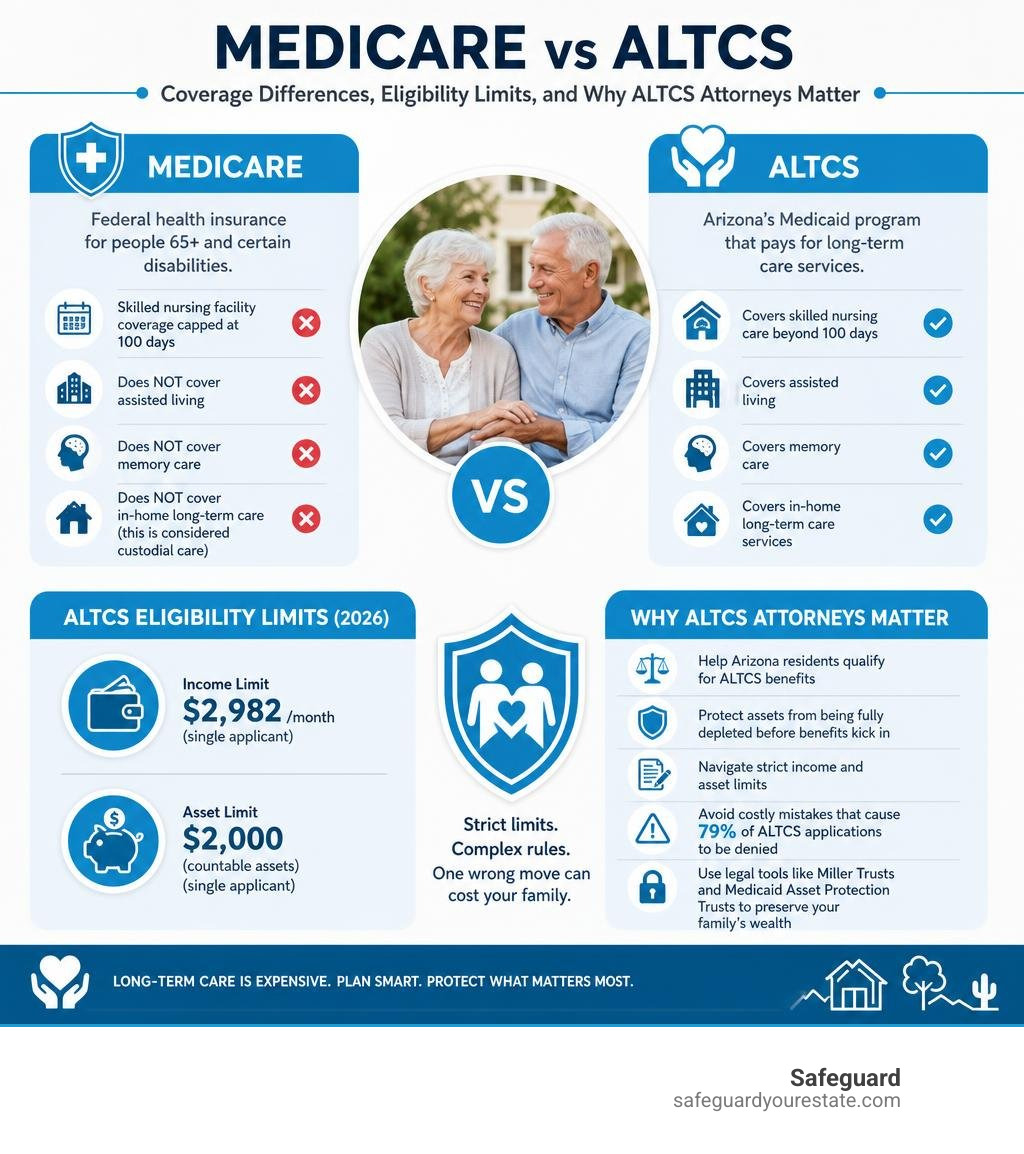
- Navigate strict income and asset limits ($2,982/month income and $2,000 in countable assets for a single applicant in 2026)
- Avoid the costly mistakes that commonly cause ALTCS applications to be denied
- Use legal tools like Miller Trusts and Medicaid Asset Protection Trusts to preserve your family’s wealth
Long-term care in Arizona is expensive. A shared room in a skilled nursing facility in Maricopa County runs around $8,000 to $8,500 per month. In-home care can cost $25 to $30 per hour or more. Most families cannot sustain those costs for long without help — and Medicare will not cover it. Medicare caps skilled nursing benefits at just 100 days and pays nothing for assisted living or memory care.
That is where ALTCS comes in. But qualifying is far from simple. The application is complex, the financial rules are strict, and one wrong move can delay benefits for months or trigger a penalty period that leaves your family paying out of pocket when they cannot afford to.
I’m Julie Jewett, Principal and Director of Operations at Safeguard Estate and Financial, and I’ve worked in the estate planning industry since 2008 helping Arizona families protect what they’ve built. While Safeguard Estate and Financial is an estate planning firm and our team members are not attorneys, we work closely with trusted legal partners who specialize as ALTCS attorneys to give families a complete, coordinated path forward. In the sections below, we’ll walk you through everything you need to know to make informed decisions about long-term care planning in Arizona.
Navigating Arizona Long-Term Care and the Crucial Role of ALTCS Attorneys

When a medical crisis hits or cognitive decline makes independent living impossible, families are often forced to make massive financial decisions overnight. The Arizona Long Term Care System (ALTCS) is a branch of the Arizona Health Care Cost Containment System (AHCCCS) — our state’s Medicaid program. Unlike standard Medicaid, which focuses on basic medical care, ALTCS is specifically designed to cover long-term care services.
Whether your loved one needs care at home, in an assisted living community, or in a skilled nursing facility, ALTCS can cover the bills. However, because it is a needs-based program, the state does not hand out these benefits easily.
Navigating the system requires a deep understanding of Arizona elder law, asset protection, and the strict guidelines used by state caseworkers. This is why specialized ALTCS attorneys are so critical. They serve as legal guides, helping families restructure their finances legally so they can qualify for benefits without spending down every penny they own.
Understanding ALTCS Eligibility, Costs, and the 2026 Financial Thresholds
To qualify for ALTCS in 2026, an applicant must meet both medical and financial requirements.
| Feature | Medicare Coverage | ALTCS (Arizona Medicaid) Coverage |
|---|---|---|
| Primary Focus | Acute medical care, rehab, and short-term recovery | Long-term care, custodial care, and daily living support |
| Skilled Nursing Limit | Maximum of 100 days (copays apply after day 20) | Unlimited days (as long as medical necessity is met) |
| Assisted Living/Memory Care | $0 (Not covered) | Fully covered at contracted Arizona facilities |
| In-Home Care Services | Limited to temporary, medically necessary home health | Covered up to designated hourly limits for daily living |
| Countable Asset Limit | No asset limits | Strict limit of $2,000 for a single applicant (2026) |
| Gross Income Limit | No income limits | Gross monthly income must be under $2,982 (2026) |
To meet the medical criteria, applicants must undergo a Pre-Admission Screen (PAS). An ALTCS assessor will conduct a face-to-face interview to evaluate the applicant’s ability to perform Activities of Daily Living (ADLs) like bathing, dressing, eating, and mobility. The goal is to prove that the applicant requires a “nursing facility level of care,” even if they plan to receive that care in their own home or an assisted living community.
Financially, the rules are incredibly strict:
- Income Limit: In 2026, a single applicant’s gross monthly income cannot exceed $2,982.
- Asset Limit: A single applicant can only keep $2,000 in countable resources.
If you are over these limits, do not panic or start giving your money away. Working with estate planning professionals to build a solid foundation of Estate Planning allows us to coordinate with legal partners who can implement specific strategies to help you qualify.
Why You Need ALTCS Attorneys to Avoid High Denial Rates and Application Pitfalls
ALTCS applications are frequently denied over avoidable paperwork and documentation errors. The process is notoriously complex, and the state reviews every detail with a magnifying glass. Caseworkers will ask for years of bank statements, tax returns, property deeds, and vehicle titles. A single missing document or an unexplained ATM withdrawal can result in an immediate denial.
Furthermore, the application process typically takes three to five months. If you apply on your own and get denied after waiting four months, you have to start the clock all over again. During those months of waiting and reapplying, skilled nursing bills will continue to pile up at $8,000+ per month, quickly draining your retirement savings.
Many families try to save money by using non-lawyer “Medicaid planners,” insurance salespeople, or online document preparation services. Unfortunately, these unqualified professionals often overlook crucial legal nuances. They cannot draft legal trusts, protect against estate recovery, or represent you in a fair hearing if your application is wrongly denied. Aligning your estate plans with qualified legal partners ensures your application is structured correctly the first time, saving your family months of stress and tens of thousands of dollars.
Strategic Asset Protection: Miller Trusts, MAPTs, and the Five-Year Look-Back Period

If your income or assets exceed the 2026 limits, specialized ALTCS attorneys use sophisticated legal tools to achieve eligibility while preserving your wealth.
The Miller Trust (Income-Only Trust) If an applicant’s gross monthly income is over the $2,982 limit but still less than the monthly cost of care, they cannot qualify for ALTCS without a Miller Trust. This is a specialized trust where any income exceeding the state’s limit is routed. The money in the trust is then used to pay for the applicant’s care or “share of cost.” When drafted correctly by an attorney, a Miller Trust completely bypasses the income barrier.
The Medicaid Asset Protection Trust (MAPT) For those with assets over the $2,000 limit, a MAPT is an invaluable tool. Unlike a standard revocable trust, which does not shield assets from Medicaid because you still control the funds, a MAPT is an irrevocable trust. Assets transferred into a MAPT are no longer counted toward your $2,000 limit.
However, you must plan ahead. Arizona enforces a 60-month (five-year) look-back period on all asset transfers. If you transfer money, stock, or real estate into a trust—or give it away to family members—within five years of applying for ALTCS, the state will penalize you.
The penalty period is calculated by dividing the total amount transferred by the average monthly cost of care (currently $8,666.72 in Maricopa, Pima, and Pinal Counties). For example, if you gifted $86,667 to a child, you would be disqualified from receiving ALTCS benefits for 10 months.
For more information on how trusts protect your assets, explore our guides on Revocable Living Trust 101 and Everything You Need to Know About Living Trusts.
Protecting the Primary Residence Your home is generally considered an “exempt” asset while you are living in it, up to an equity limit of $752,000. However, if you do not plan carefully, the state can file a TEFRA lien against your home or seek reimbursement through Medicaid Estate Recovery after you pass away. Specialized attorneys can structure your property ownership to protect your home from estate recovery, ensuring it passes safely to your children. For more details on these rules, you can read the comprehensive overview provided by AHCCCS’s official ALTCS program overview.
Protecting Married Couples and Vulnerable Adults from Financial Exploitation
When one spouse needs long-term care but the other is still healthy and living at home (referred to as the “community spouse”), the state implements rules to prevent the healthy spouse from becoming impoverished.
Through the Community Spouse Resource Assessment (CSRA), the healthy spouse is allowed to keep a portion of the couple’s combined assets. In 2026, the minimum CSRA is $32,532, and the maximum is $162,660. Additionally, the Community Spouse Monthly Income Allowance (CSMIA) allows the healthy spouse to keep a portion of the applicant’s income if the healthy spouse’s independent income is below state-mandated limits.
Beyond spousal protection, elder law attorneys also address issues of incapacity and adult protection. If a senior is suffering from advanced dementia and can no longer make decisions, the family may need to seek court-ordered guardianship (for medical and personal decisions) or conservatorship (for financial management).
Sadly, cognitive decline also makes seniors prime targets for financial exploitation. Arizona has incredibly strict laws to protect vulnerable adults. If a family member, caregiver, or scammer is taking advantage of a senior, elder law attorneys can step in to halt the exploitation and recover stolen assets. Integrating these protective measures into your broader Retirement Planning is the best way to safeguard your family. To learn more about protective advocacy for your family, reach out to our team.
Securing Your Legacy with Safeguard Estate and Financial
At Safeguard Estate and Financial, we understand that long-term care planning is not just about filling out state applications — it is about protecting your dignity, your hard-earned savings, and your family’s future.
We are estate planning and wealth preservation professionals. While we are not a law firm and do not act as attorneys, we simplify these complex financial landscapes for families in Scottsdale, Oro Valley, and Tucson. We serve as your primary strategists, aligning your retirement goals and living trusts with Arizona law, and we partner with top-tier ALTCS attorneys to handle the specific legal filings and trust creations.
By organizing your estate and establishing robust living trusts, we help you build a defensive wall around your assets. Discover how we can help by reviewing Why Estate Planning is Important, exploring our approach to Wealth Preservation, or taking a look to learn more about our comprehensive services.
How Our Estate Planning Partners and ALTCS Attorneys Align to Protect Your Future
The most effective long-term care plan is a proactive one. If you wait until a medical emergency occurs, your options to protect your assets are severely limited by the five-year look-back period. By starting your planning in your 60s, you can quietly and legally transfer assets into protective trusts, clear the look-back window, and significantly improve your chances of qualifying for ALTCS if you ever need it.
Our team at Safeguard Estate and Financial works hand-in-hand with our legal partners to create a seamless, stress-free experience:
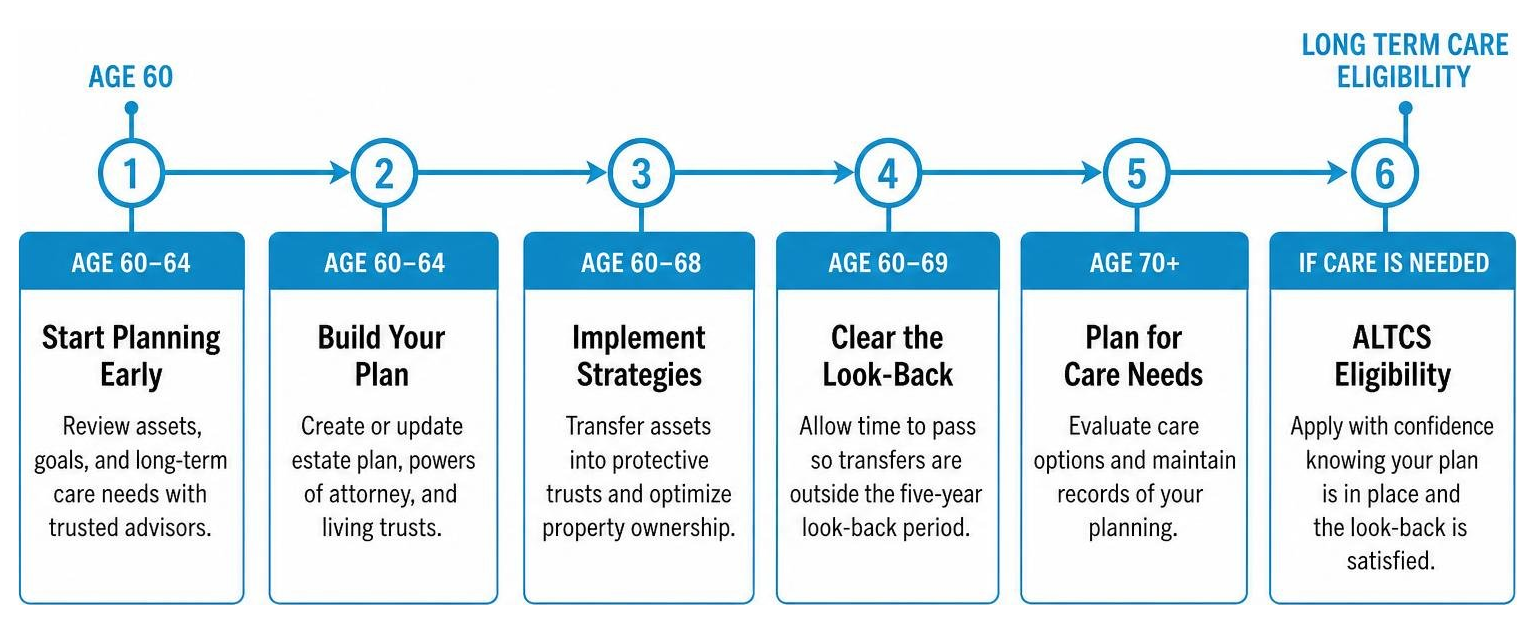
Through this collaborative approach, we ensure that your revocable living trusts, powers of attorney, and asset protection strategies are perfectly aligned. We help you avoid the nightmare of probate, minimize taxes, and help make sure that if the time ever comes to apply for ALTCS, your application is as strong as possible.
Don’t wait for a health crisis to dictate your family’s financial future. Contact us today to schedule an Estate Planning Consultation and let us help you secure the peace of mind you deserve.