 Search

October 15, 2026 • General
Legal Essentials and How to Set Up Trust Foundations in Arizona
To set up a trust in Arizona, first select your beneficiaries and decide whether you will serve as trustee or appoint a successor to manage the property. Next, draft a trust agreement that reflects Arizona law; sign it before a notary public; and then fund the trust by retitling your home, bank accounts, and other assets into the trust’s legal name. This creates a binding fiduciary relationship governed by the Arizona Trust Code (A.R.S. Title 14, Chapter 11). To understand how the structure operates, you need to know the three core roles:
- The Grantor (Settlor): You, the creator of the trust, who contributes the initial property.
- The Trustee: The individual or institution managing the trust property. With a standard revocable living trust, you typically serve as your own trustee during your lifetime.
- The Beneficiary: The persons, charities, or entities entitled to receive income or principal from the trust.
A key advantage of establishing a trust is naming a successor trustee. If you become incapacitated or pass away, your chosen successor steps in immediately to manage assets without requiring a court-appointed conservatorship or enduring the Arizona probate court process.
| Feature | Revocable Living Trust | Irrevocable Trust |
|---|---|---|
| Grantor Control | Retain total power to alter, amend, or revoke | Generally permanent; alterations require court or beneficiary consent |
| Tax ID (Lifetime) | Uses Grantor’s personal SSN | Requires separate EIN from the IRS |
| Probate Avoidance | Yes, for all properly funded assets | Yes, for all trust assets |
| Asset / Creditor Protection | Limited lifetime protection from personal creditors | Strong shielding against outside lawsuits and personal creditors |
| Estate Tax Reduction | Included in taxable estate | Can remove appreciation and principal from gross estate |
Comparing Revocable vs. Irrevocable Trusts in Arizona
Choosing the right structure depends on whether your priority is daily flexibility or strict asset shielding. We frequently guide clients through everything you need to know about living trusts so they can evaluate these tradeoffs.
A revocable living trust gives you complete autonomy. You can buy real estate, sell investments, change your beneficiaries, or dissolve the trust entirely at any time. Under Arizona revocable living trust laws, the trust property remains accessible for your personal care and expenses.
An irrevocable trust, by contrast, requires you to surrender ownership and control of the transferred assets. In exchange, the Arizona Trust Code allows for robust spendthrift protections that shield trust assets from outside creditors, judgments, and certain long-term care costs. While an irrevocable trust is an exceptional tool for high-net-worth tax strategies or specialized asset protection, most households prioritize the flexibility of a revocable framework. For a deeper look at state-specific requirements, review our guide to Arizona revocable living trust laws.
Core Procedures on How to Set Up Trust Documents Properly
Drafting your trust document requires strict adherence to Arizona execution standards. While DIY templates cost between $100 and $500 online, generic kits frequently overlook state-specific statutory language or fail to coordinate properly with your broader estate documents. By contrast, an estate planning package prepared with professional guidance ensures all instruments operate in harmony.

- Drafting the Trust Agreement: Outline distribution terms, sub-trust provisions for minor children or special needs beneficiaries, and specific trustee powers.
- Creating a Certificate of Trust: Under A.R.S. § 14-11013, this streamlined summary proves your trustee powers to banks without disclosing your private distribution terms or beneficiary details.
- Execution and Notarization: Sign the trust agreement before an authorized Arizona notary public to verify authenticity and legal capacity.
- Drafting a Pour-Over Will: A pour-over will acts as a critical safety net, directing any forgotten individually owned assets into your trust upon your death.
- Understanding Public Records: When executing your estate plan, review how to handle formal recordings; for instance, the details in How to Register a Living Trust and Will in Arizona explain why living trusts remain private documents while wills are lodged only after death.
To avoid costly execution errors, you can explore the fundamentals in our overview of revocable living trust 101.
Transferring Assets and How to Set Up Trust Funding
A trust document without assets is simply an empty container. Realizing the benefits of your trust requires retitling your assets into the trust’s legal name.
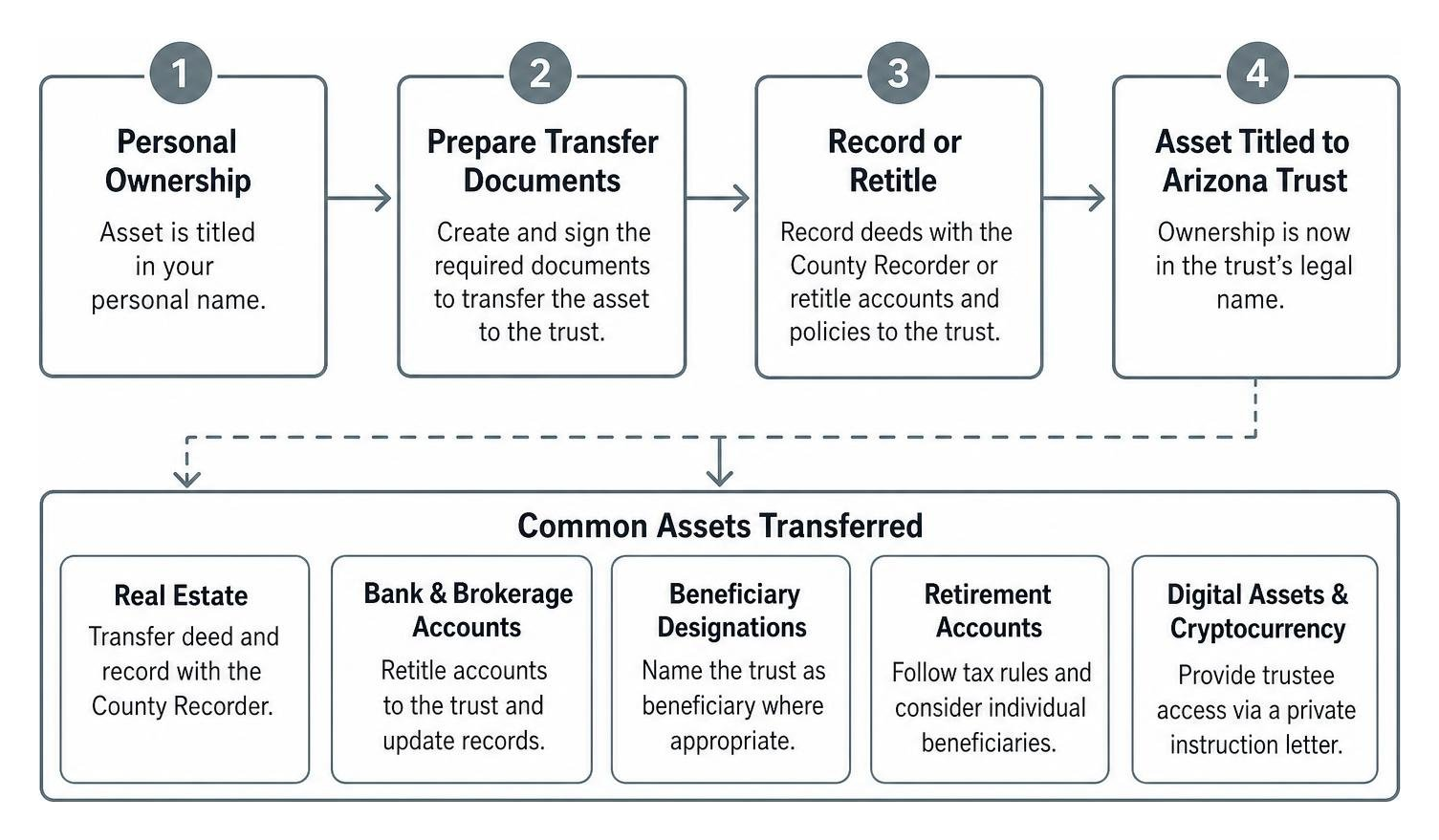
- Residential and Commercial Real Estate: To transfer an Arizona home, you must prepare and execute a new deed (such as a special warranty deed or quitclaim deed) and record it with the appropriate County Recorder (such as Maricopa or Pima County). Review the exact paperwork needed to put a house in a trust in Arizona to ensure property descriptions match existing county recorder filings.
- Bank and Brokerage Accounts: Retitle personal checking, savings, and non-retirement investment accounts to the trust. Refer to our living trust bank account complete guide for a detailed walkthrough on presenting your Certificate of Trust to financial institutions.
- Beneficiary Designations: Life insurance policies can name your trust as primary or contingent beneficiary. For qualified retirement accounts like 401(k)s or IRAs, naming individual beneficiaries directly is often preferred to preserve income tax stretch rules, though specific trust clauses can manage inheritances for minor children.
- Digital Assets and Cryptocurrency: Document wallet access, exchange accounts, and hardware keys in a private letter of instruction, giving your trustee legal authority to manage digital property without disclosing passphrases in public records.
For additional practical steps on account establishment, consult this step-by-step review on how to start a trust account.
Tax Filings, Fiduciary Duties, and Post-Death Administration
During the grantor’s lifetime, a standard revocable living trust is treated as a “grantor trust” by the IRS. You do not need a separate Employer Identification Number (EIN), nor do you file an independent tax return; all income and deductions pass directly to your personal IRS Form 1040.
When the grantor passes away, the trust becomes irrevocable and requires its own unique EIN. Under federal rules, if an irrevocable trust generates $600 or more in gross annual income, the trustee must file IRS Form 1041. Any taxable income distributed to beneficiaries is reported on a Schedule K-1.
From a transfer-tax perspective, the federal estate tax exemption for 2026 is indexed to approximately $15 million per individual (and roughly $30 million for married couples). Arizona does not assess a separate state estate tax or inheritance tax.
Throughout trust administration, trustees must adhere strictly to fiduciary duties:
- The Prudent Investor Rule: Managing and diversifying trust assets responsibly.
- Duty of Loyalty: Administering the trust solely in the interest of the named beneficiaries without self-dealing.
- Duty of Impartiality: Balancing the interests of current income beneficiaries with remainder beneficiaries.
- Accurate Accounting: Maintaining clear records of all receipts, disbursements, and distributions.
For practical perspectives on ongoing administration, see the procedural breakdown in this guide on setting up a trust.
Common Estate Pitfalls and Getting Started in Arizona
The single most common estate planning error is failing to fund the trust after executing the initial paperwork. An unfunded trust provides zero probate avoidance.
In Arizona, if assets remain in your personal name at death, your family can only bypass formal probate if your estate falls below the statutory thresholds under A.R.S. § 14-3971 for a small-estate affidavit:
- Personal Property: Total net value of all personal property must not exceed $75,000.
- Real Property: Total net equity in Arizona real estate must not exceed $100,000.
If your real estate equity or personal holdings exceed those statutory limits, an unfunded estate must pass through probate, exposing your family to court delays, statutory fees, and public disclosure of assets.

Life evolves, and your estate plan should evolve with it. We recommend reviewing your trust terms every three to five years, or immediately following major life events such as a marriage, divorce, birth of a child, purchase of a new home, or relocation.
Safeguard Estate and Financial offers comprehensive estate planning services across our offices in Scottsdale, Oro Valley, and Tucson. We are estate planning professionals with legal partners, not lawyers or attorneys. We collaborate closely with vetted legal counsel to design complete, synchronized estate solutions tailored to Arizona law.
To protect your legacy and streamline your estate, schedule a consultation to set up your Arizona family trust with our team today. You can also explore our broader array of estate planning services or book an estate planning consultation to begin securing your family’s future.