 Search

March 27, 2026 • General
Why Arizona Families Need a Clear Path to Estate Protection
Family trust Arizona estate planning offers a powerful way to protect your assets, avoid probate, and maintain control over how your wealth is distributed to loved ones. Unlike a will, a family trust in Arizona keeps your affairs private, bypasses lengthy court processes, and can shield your legacy from creditors and legal disputes.
Quick Answer: What You Need to Know About Family Trusts in Arizona
- Probate Avoidance: Assets in a trust bypass the public probate process, which typically takes a year or more and costs thousands in legal fees
- Control: You decide when and how beneficiaries receive assets (at age 25, upon marriage, etc.)
- Privacy: Trust documents remain private, unlike wills which become public record
- Protection: Shields assets from creditors, lawsuits, and family conflicts
- Flexibility: Revocable trusts allow changes anytime; irrevocable trusts offer stronger tax and creditor protection
- Arizona Thresholds: Probate triggers at $200,000 personal property or $300,000 real estate
If you’re an Arizona resident trying to figure out how to protect your family’s future without the confusion and stress of complicated legal jargon, you’re not alone. 94% of people define a life well lived by having family and friends who love them, yet 35% face family conflict during estate planning.
A family trust isn’t just for the wealthy. It’s a practical tool that gives you peace of mind knowing your home, savings, and personal belongings will go exactly where you want them—without court delays, public scrutiny, or family arguments.
The good news? Setting up a family trust in Arizona is more straightforward than most people think. You just need to understand the basics, avoid common mistakes, and work with professionals who can guide you through the specifics of Arizona law.
Understanding the Family Trust Arizona Framework

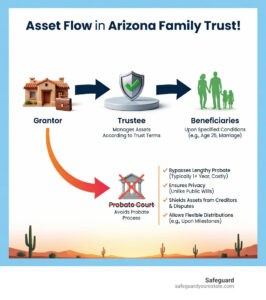
At its heart, a family trust Arizona is a legal “bucket” created to hold your assets for the benefit of your family members. In Arizona, these arrangements are governed by the Arizona Trust Code (Title 14, Chapter 11 of the Arizona Revised Statutes). Think of it as a contract between you and a person you trust to manage your stuff if you aren’t able to.
To understand how this works, we need to look at the three main roles defined in A.R.S. § 14-10103:
- The Settlor (or Grantor): That’s you! You are the one who creates the trust and puts your property into it.
- The Trustee: This is the “manager.” During your lifetime, you are usually your own trustee. You also name a “successor trustee” to take over if you pass away or become incapacitated.
- The Beneficiaries: These are the people (usually your spouse, children, or grandchildren) who eventually receive the benefits of the trust assets.
One of the most important parts of this framework is the fiduciary duty. This is a fancy legal way of saying the trustee has a strict obligation to act in the best interest of the beneficiaries. They can’t just take the money and run to Las Vegas; they must follow your written instructions to the letter.
Beyond just passing on money, a family trust provides a safety net for incapacity planning. If you were to become ill and couldn’t manage your finances, your successor trustee can step in immediately to pay your bills and manage your home without having to ask a court for permission. This keeps your private business out of the public eye and ensures your care is handled exactly how you wanted.
Revocable vs. Irrevocable Family Trust Arizona Options
When we sit down with families in Scottsdale or Tucson, the first big decision is usually whether the trust should be revocable or irrevocable. It’s a bit like choosing between a pencil and a permanent marker.
- Revocable Trusts: These are the most common for Arizona families. A revocable trust gives you the most control. You can usually change it, add or remove assets, or revoke it during your lifetime. It works well for probate avoidance, privacy, and incapacity planning, but it generally does not protect assets from your own creditors.
- Irrevocable Trusts: An irrevocable trust is much harder to change once it is created. In exchange for giving up some control, it may offer stronger asset protection, possible estate tax advantages in the right situation, and can sometimes support Medicaid planning. Like revocable trusts, it can also keep family matters more private than probate.
Key Parties Involved in Your Trust
Choosing the right people for your trust is just as important as the legal language itself.
- The Grantor: As the creator, you set the rules. You decide if a child gets their inheritance all at once or in small “milestones” (like graduating college or turning 30).
- The Successor Trustee: This is your “backup quarterback.” They step in only when you can no longer manage things. We often suggest choosing someone who is not only trustworthy but also good with paperwork.
- Qualified Beneficiaries: These are the people currently entitled to receive distributions. Under Arizona law, they have certain rights to be informed about how the trust is being managed.
- Power of Withdrawal: This is a specific power you might give a beneficiary to take out a certain amount of money under specific conditions.
If you’re feeling a bit overwhelmed by these roles, don’t worry. Our team at Safeguard Your Estate specializes in helping you navigate these services to find the perfect fit for your family dynamic.
Why Arizona Families Choose Trusts Over Wills
You might be asking, “Why can’t I just use a simple will?” While a will is a great starting point, it has one major flaw: Probate.
In Arizona, a will is essentially a letter to a judge. It tells the court how you want your things handled, but the court still has to oversee the process. This is the probate process, and it is public, slow, and expensive. Handling the emotions of losing a loved one is hard enough; adding a year-long court battle over a bank account makes it much worse.
A family trust Arizona avoids this entirely. Because the trust “owns” the assets, there is no need for court intervention. Your family can access funds and transfer property almost immediately. This is especially helpful if you own real estate in multiple states. Without a trust, your family might have to go through probate in Arizona and whatever other state the property is in. That’s double the paperwork and double the legal fees!
Navigating Arizona Probate Thresholds
Arizona law does provide some “shortcuts” for very small estates, but the bar is surprisingly low. If your assets exceed these limits, probate is usually required.
According to Ariz. Rev. Stat. § 14-3971, the thresholds prior to 2025 for using a small estate affidavit were:
- Personal Property: $75,000 or less
- Real Estate: $100,000 or less
However, thanks to 2025 Ariz. HB 2116, these numbers had a major jump. Beginning September 26, 2025, the thresholds increased to:
- Personal Property: $200,000
- Real Estate: $300,000
While these increases are helpful, most homeowners in Scottsdale, Oro Valley, and Tucson will still find their homes valued well above the $300,000 mark. This makes a family trust an essential tool for almost every Arizona homeowner who wants to keep their family out of court.
Privacy and Conflict Reduction
Did you know that once a will enters probate, it becomes a public document? Anyone—including nosy neighbors, estranged relatives, or even scammers—can go to the courthouse and see exactly what you owned and who you left it to.
A trust, however, stays private. It’s a private contract that stays within the family. This privacy is one reason why many choose trusts to reduce conflict. Research shows that 35% of Americans have experienced conflict during estate planning, but 53% chose to create a trust specifically to ease those tensions. By providing clear, indisputable instructions, you take the guesswork (and the arguments) out of the equation.
Whether you are in our Tucson office or visiting us in Oro Valley, we make sure your trust is built to keep the peace. You can find more info about our locations to see which office is closest to you.
How to Set Up and Fund Your Trust
Setting up a family trust Arizona isn’t a “one-and-done” paperwork shuffle. It’s a process that ensures your goals are actually met. Here is the typical “how-to” path we follow:
- Define Your Goals: Do you want to provide for a spouse? Protect an inheritance from a child’s future divorce? Support a local charity?
- Choose Your Trustee: Pick someone who is organized and can handle the responsibility.
- Draft the Document: This is where the legal heavy lifting happens. We ensure your trust complies with all Arizona-specific statutes.
- Notarization: To be valid in Arizona, the trust must be signed and notarized.
- Communication: Talk to your beneficiaries. Let them know what to expect so there are no surprises later.
As the American Bar Association notes, it is never too early to plan your estate. Starting early gives you the flexibility to make adjustments as your life changes.
Essential Steps to Fund Your Family Trust Arizona
This is the step where many DIY plans fail. A trust is useless if it’s empty. You must “fund” the trust by transferring the titles of your assets into the name of the trust.
- Real Estate: You need to record a new deed (often a Warranty Deed or Quitclaim Deed) at the County Recorder’s office. In Arizona, Ariz. Rev. Stat. § 33-405 also allows for “Transfer-on-Death” deeds, but a trust offers much more comprehensive control.
- Bank Accounts: You’ll need to visit your bank and update the ownership of your accounts to the name of the trust.
- Beneficiary Designations: For things like life insurance, you may want to name the trust as the beneficiary so the funds can be managed by your trustee for your family’s benefit.
The biggest mistake we see is people creating a beautiful trust document and then forgetting to retitle their house. If the house is still in your name when you pass away, it’s headed straight for probate court!
Ongoing Maintenance and Reviews
At Safeguard Your Estate, we don’t just hand you a folder and say goodbye. We believe in building long-term relationships. You can learn more about our team and how we support our clients through all of life’s transitions.
Asset Protection and Tax Strategy
One of the coolest things about a family trust in Arizona is its ability to act as a financial shield. If you use an irrevocable trust, the assets inside are generally protected from lawsuits and creditors. If you get sued personally, those assets aren’t “yours” anymore—they belong to the trust.
Even with a revocable trust, you can include spendthrift provisions. These prevent your beneficiaries from “pledging” their inheritance to creditors or losing it all in a lawsuit. It’s a way to protect your children from their own financial mistakes or the bad luck of a failing business.
On the tax side, the federal estate tax exemption is quite high right now ($13.99 million per individual in 2025), so most families don’t have to worry about “death taxes.” However, for those with larger estates, specific trust structures like Generation-Skipping Trusts can help move wealth down to grandchildren without triggering massive tax bills.
Protecting Minor and Special Needs Beneficiaries
If you have minor children, a trust is non-negotiable. Without one, the court will decide who manages the money for your kids until they turn 18. And let’s be honest—most 18-year-olds aren’t ready to handle a large inheritance. A trust allows you to set milestone distributions. For example:
- 1/3 at age 25
- 1/3 at age 30
- The remainder at age 35
For families with special needs beneficiaries, a trust is even more critical. A standard inheritance could disqualify them from essential government benefits like SSI or AHCCCS (Arizona’s Medicaid). A “Special Needs Trust” allows them to have the benefit of your assets for things like extra therapy, travel, or hobbies without losing their government safety net.
Frequently Asked Questions about Arizona Trusts
Do I still need a will if I have a family trust?
Yes! We always include what’s called a “Pour-Over Will.” This acts as a safety net. If you forgot to put a specific asset into your trust, the pour-over will “catches” it and moves it into the trust during probate. It also serves the vital role of naming guardians for your minor children—something a trust cannot do.
How does a family trust differ from a living trust?
In Arizona, the terms are often used interchangeably. However, a “family trust” is usually a type of living trust specifically designed for family members. It often includes specific language about generational wealth and family-specific goals, whereas a general living trust could benefit anyone, including charities or friends.
What are the common pitfalls to avoid?
The “Big Three” mistakes we see are:
- Failure to Fund: Not retitling assets (the “empty bucket” problem).
- Wrong Trustee: Choosing someone based on emotion rather than ability.
- Ignoring Updates: Letting a 20-year-old trust sit in a drawer while laws and family dynamics change.
Conclusion
Securing your legacy shouldn’t be a source of stress. By establishing a family trust in Arizona, you are giving your loved ones a roadmap for the future. You are ensuring that your hard-earned assets stay in the family, out of the courts, and away from public prying eyes.
At Safeguard, we pride ourselves on simplifying these complex processes. Whether you are in Scottsdale, Tucson, or somewhere else in Arizona, our team is here to provide the alignment and personal touch you need for true peace of mind.
Don’t leave your family’s future to chance. Secure your legacy with our services today and take the first step toward a protected tomorrow.